


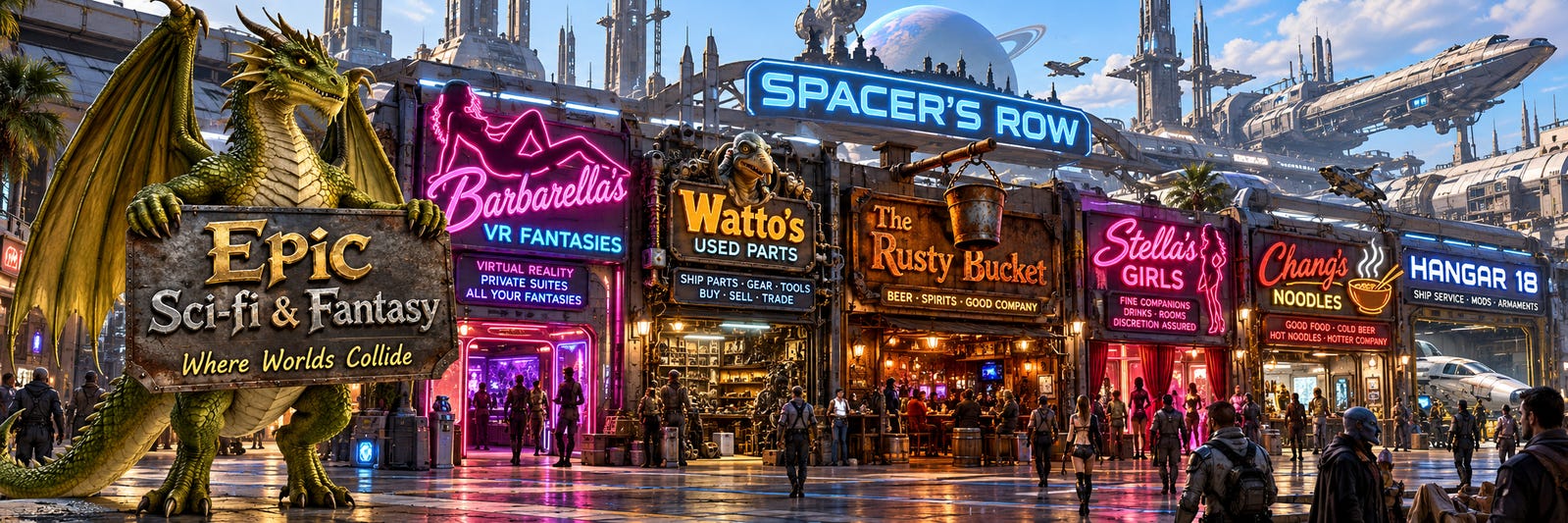
My novelette, An Illicit Mercy, is part of a new promotion in November and December: Epic Sci-Fi & Fantasy.
Over 50 books available at no cost!

Will humanity come together to save a dying Earth?
Get your FREE copy of A Fading Star by Greg Hickey
Earth is dying. Ravaged by disease, hunger, climate change and world wars. Can humanity unite to avoid extinction?
In 2153, cancer was cured. In 2189, AIDS. It seemed like humanity was headed for the stars.
Global population soared, surpassing 24 billion. Then came the floods, washing over Bangkok, Buenos Aires, Mumbai, Jakarta, Dhaka and New Orleans. Then a fourth world war, with 289 million casualties. Frequent droughts plague Los Angeles, Phoenix, Las Vegas, Melbourne, Mexico City, São Paulo, Stockholm, Vienna and Moscow. Now humanity teeters on the brink of extinction.
A few individuals fight for our survival. A determined physicist. A brilliant oncologist. A team of daring astronauts. A small group of investors funds a desperate search for another habitable planet.
But time is running out.
by Brian Scott Pauls
Recorded November 19, 2026. This transcript has been lightly edited for clarity. Notes have been added for reference.
Brian Pauls: Welcome, Nick, to the Cosmic Codex!
Nick Hoekstra: Thank you, Brian. It’s a pleasure to come here and talk about an actual fun topic, something different from work and the normal reasons I’m on Zoom calls.
Brian: Definitely, yes. So, I would like to start out asking what interested you in speculative fiction. What’s your origin story when it comes to science fiction, fantasy, that type of literature?
Cloudessy, my consulting business providing fractional Chief Technology Officer services, is a sponsor of this newsletter. If you or someone you know needs professional tech guidance for their author, coaching, or independent publishing business, check out the ad at the end of this post. Thank you!
Nick: It’s hard to pinpoint a precise origin, but some of my earliest memories are of my neighbor, who was a teenager when I was four, five, six years old. I remember being at their house and seeing the types of books they were reading, and they were reading books with dragons on the covers, and fantastical things. This was back in the late 1980s, early 1990s. I remember they had a super old computer in their basement, and they were playing some games on the computer, which, looking back on it, might have been something like a Final Fantasy, or something similar. And I remember just being really taken in by what I was seeing, including on the book covers.
For context, I should say that I am blind as an adult, but I was sighted until I was eight years old. So I do have some very early memories of these really attractive, fantastical book covers, and that just piquing my interest, and then asking my neighbor, “What is this about? What happens in the story? Tell me about the different dragons,” and things like that.
It really got me interested. And then, also as a kid, my mom read a lot of different literature to me, so it just got me down that path—I would say more fantasy at first, and then eventually I started exploring more science fiction and speculative fiction from there.
Brian: Okay, very good. What, if I can ask, caused you to go blind by the time you were an adult?
Nick: I lost my sight when I was eight years old, and it was a type of brain tumor, but it wasn’t the cancer type of brain tumor. It was a blockage that caused fluid to back up right behind the optic nerve. I’m not sure why they refer to that as a tumor, but I guess anytime there’s an increase in biomass in a particular location, maybe they call it a tumor. As the blockage caused more fluid to back up in that central location, it started to squeeze the optic nerves, and they just didn’t realize what was going on until it was a little bit too late.
Brian: Understood. So, you currently work with a program that is bringing accessible literature to folks who can’t just sit down and crack open a book like some of the rest of us. You want to tell us a little bit about that?
Nick: Yeah. Right now, I work for an organization called the Accessible Books Consortium. They are a project housed within the World Intellectual Property Organization, which is a UN entity—it’s one of the UN organizations. The Accessible Books Consortium came about thanks to some great global efforts by people who were blind or visually impaired saying, “We need greater access to books in accessible formats.”1
One of the biggest barriers is copyright and intellectual property laws. When you have a lot of laws in countries that say, “Hey, you cannot reproduce this book in any way”—we understand that that’s there to protect against piracy, but it was also creating barriers for people who are blind or visually impaired who needed those books in an accessible format.
So lots of blindness organizations got together and started petitioning their governments to make a treaty allowing for the production of books in accessible formats without requiring authorization from the copyright holder.2 And it’s very strict what we do. It’s for people who are blind or visually impaired, or otherwise print-disabled—so also for people with dyslexia, for example. We hold pretty closely to that, because it’s also important for us to protect authors’ rights, and we’re not trying to distribute books to the general public. We make sure that the books we help produce are just going for the use of the people who otherwise couldn’t access them.
Brian: For sure. And you are a graduate student now at the University of Kansas?
Nick: Yes, I’m a graduate student in the Department of Special Education.
Brian: Okay, very good. I recently had the opportunity to hear you speak at the Sturgeon Symposium on the campus of KU, and I was very intrigued by your topic, which was how disability is handled in fantasy literature. This struck close to home for me because, as I told you in the email, my eldest daughter is visually impaired. She was born in China during the one-child policy, and she was the second child, and she was born with congenital cataracts—a super easy problem to fix if you have access to a hospital and a doctor who can do the surgery, but under that policy, which thankfully has been retired, she did not qualify. So we adopted her when she was 10 and immediately got her cataracts removed.
Most people, and I, thought, “Okay, well, that should take care of it.” Well, it turns out your visual development happens in your brain by the age of three, and if you can’t see very well, the brain doesn’t have enough plasticity to adjust, even if the images coming in are perfect going forward. So when I heard what you were writing about in your paper, I was very interested—probably way more interested than my daughter would be. I’ve tried to get her interested in fantasy and science fiction literature, but she does like fantasy movies and television shows. So I would like you to tell us about that paper, and your thesis, and what you found.
Nick: That’s great, and I want to preface this by saying it was a very random series of events that led me to this conference. I am in the Department of Special Education, and one of my biggest criticisms is that oftentimes people in special education, or in any department, stay within their department. I’ve never really liked that, because I think part of the work that we do in special education needs to be awareness raising, needs to be advocacy.
My wife is really good at just reading emails, something that I tend to be less good at. So she saw an email at some point about the Sturgeon Symposium and said, “You should definitely write something for this.” I found the topic really interesting, and one of the ideas that occurred to me was this overlap—how people with disabilities are being represented in fantasy—probably because I’ve come across a couple of examples within the last couple of years, and it’s just stuck in my head that this would be really interesting to explore.
I always keep a running list of books that I’ve read, with a few notes, so that down the line I can remember what I read last year, what I read two years ago. I went back to my list of books, went through my notes, and remembered a few books that I’d read.
As I put this together, I thought, “What would be really cool is to look at this over the course of maybe a 50-year span.” So I ended up picking basically one book per decade, from about 1980 up through the present day. I think I maybe missed a decade, or had two books from the more recent years, but by and large it’s an overview of the last 50 years, touching upon how the representation of disability within fantasy has changed.
Brian: And what did you learn?
Nick: What I learned did not necessarily surprise me, but what I learned is that we’ve actually made good progress over the past 50 years in terms of a more authentic representation of disability and a more positive representation of disability. When I looked at titles from the late 1970s, early 1980s, typically what I found were two broad ideas.
One is that disability was something you needed to cure with magic. That could be being transported to a magical world, or it could be magical powers that overcome your disability and kind of eliminate it.
The other idea that I often found is that people with disabilities, when represented in fantasy, were typically represented as being bitter, angry, and out for revenge. Sometimes that meant they were the villains. Other times it meant they were, more or less, the antihero—somebody cast in a main character role, but whose motivation was all about anger at the world for their disability.
So early representations were really what I would call stereotypical of that time: if you have a disability, you must be unhappy, and you’re just looking for a cure.
Whereas in the most recent representations of disability, out of the past couple of years, I have now come across more literature where people with disabilities are integrated as a part of society. If magic is used, it’s used more as an assistive technology, such as a floating wheelchair or a prosthetic limb.
I like that, because it reflects a little bit more how we, in the real world, use technology to help us overcome the limitations that disabilities create. But we’re not curing the disability. These are still people with disabilities, they’re still recognized as characters with disabilities, but we can take advantage of this magic that exists in the world to maybe overcome some of the barriers. And also—well, let me pause there, because I’m rambling a lot.
Brian: Well, I’m curious if you can share some examples—an example of how it maybe could have been done better, from the early part of the modern history of the genre, and an example from more recent history of how it has been done in a way that you feel is more appropriate.
Nick: Yep. One of the earliest examples that I found was a book called The Sleeping Dragon by Joel Rosenberg.3 It was, I think, one of the very earliest examples of what you might consider a LitRPG.4 It was a group of characters who, during a gaming night around a table, are transported by their game master to a fantasy world. And one of those characters is a man with cerebral palsy. [In the novel, the character, James Michael Finnegan, has muscular dystrophy.]5
You start the book out in large part from his perspective, and his perspective recognizes how difficult it can be to have cerebral palsy. There’s the worry about how people are judging you. There’s the worry, “Are people treating me differently because of my disability?” Those are real. Those are legitimate concerns that people with disabilities have.
But it’s always framed within this anger—constant anger on the part of the character, and lashing out at other people. If someone’s kind to him, the character lashes out at them, out of his fear that they’re treating him differently because of his disability. He doesn’t want to be treated—
Brian: Treated with pity.
Nick: Exactly, he doesn’t want to be treated with pity. And again, this is completely legitimate. I don’t want to underestimate that sensation, because as an individual who lost their sight very young, I definitely had some of those feelings as well.
But once they’re transported to the fantasy world, it’s almost completely forgotten that the character ever had a disability, except for the rare time when he says, “I will never go back to the real world, because I don’t want to be a cripple again,” that kind of thing. So there’s a complete abandonment of that aspect of his identity. I’ve read later books, and I don’t recall it even being brought up again.
So if we’re talking about how it could have been done better, I think it would have been very interesting to discuss, at a minimum, how the disability maybe impacted his understanding of differences among people in the fantasy world—“I had this experience of being discriminated against; maybe this will inform my way of treating others in the fantasy world.” Or he could have maintained some level of disability within the fantasy world. But that’s definitely not the case. It’s more just forgotten about, and used as a reason to justify why a character would not want to return home.
Brian: And how have you seen it done well?
Nick: A really recent example is from a book called Godkiller by Hannah Kaner.6 This was a book that I had not heard of. I saw it advertised just randomly, and I picked it up about a year ago, and actually just had it on my virtual bookshelf since then. When I was doing some searching on Google for positive representation of disability in literature, the name came up, and I said, “You know, I have that book, and I’ve been meaning to read it.”
What impressed me about Godkiller is the fact that there are characters with multiple disabilities. There’s a character who’s missing a leg, there are characters who are deaf, and there are characters who are coded as being autistic.
What is interesting is that their disability was not used to justify their presence in the story, if that makes sense.
Brian: Sure.
Nick: We’re not giving the character a disability just so we can say, “Oh, we have a character with a disability.” Their disabilities were treated very much as a natural part of the story, and there are some great examples within the book. You have the main character, who has a prosthetic leg, and in the middle of a conversation with other characters, she will be attaching her prosthetic leg and thinking to herself about the phantom pains that she feels down the shin that’s no longer there, or just the difficulty of strapping it on, of fitting the prosthetic foot into the boot.
But these are all presented very naturally, just as another character might be described putting on their pants. It’s part of what this person does on a daily basis to get around. And the character then goes out and battles deities, helps lead the overthrow of a kingdom, things like that. So she’s a very positive, powerful character, with disability treated as a very natural part of who she is.
Brian: Well, we are a science fiction podcast, and I love this premise and what you have done with it in the fantasy realm. Honestly, I could probably do an hour just talking with you about that. I’ve got so many examples that I’d like to discuss and get your input on. But I am interested—as someone who has read some science fiction as well, do you feel that the same thesis applies in the science fiction domain as in the fantasy domain?
Nick: This is interesting. One of the biggest things I think I’ve realized is that there’s actually much more representation of disability within science fiction, for whatever reason. As I was discussing this with others and doing a little bit of research, I found there are a lot of science fiction books with people with disabilities.
I’m not sure exactly why that is, but I think, to some degree, in science fiction we think about our world in a more futuristic state. Not always, but broadly speaking, a lot of science fiction is projecting our world into the future. And it’s really easy for us to see people with disabilities around us and imagine that projected into the future. With fantasy, which is typically a projection of our world into the far past, we have fewer examples of how disability existed in the far past. So perhaps it’s just more difficult for us to think about that.
But there is a lot of disability in science fiction. I know there are many examples of things like mech suits that can be used to overcome disability. There’s also taking the mind a little bit out of the physical body and making it part of a greater network, which can kind of avoid disability.7 I don’t have a lot of good examples of what a positive or negative representation looks like in modern-day science fiction, but I am definitely going to be thinking about this more, and maybe a year or two from now we can come back and have a conversation about science fiction today and what that looks like.
Brian: I would love to do that. Most people are somewhat familiar with Flowers for Algernon.8 Is that one that you’ve read?
Nick: I have. I’ve read it a couple of times. I read a shortened version of it during elementary school, and then as an adult I read the full version. So yes, I’m very familiar with it.
Brian: How do you feel Keyes handled the topic of mental disability in that story?
Nick: I have seen some criticisms of the way mental disability is handled. It has been a couple of years since I’ve read it, but based on my memories, what we see is that when somebody becomes intelligent, they’re able to recognize how poorly treated they were when they were less intelligent.
I think one of the major problems with that—it’s an interesting idea, and I don’t completely disagree, but I think what the author maybe underestimates is that people with intellectual disabilities are remarkably capable of recognizing when they’re being mistreated. Not always. But I think it undersells a little bit that potential of somebody with an intellectual disability actually recognizing, “You know what, the way I’m being treated is not fair, or is not okay.”
Brian: Right. You don’t have to be able to do higher math in order to feel like you’re being treated unfairly.
Nick: Exactly. Now, that would be the criticism side. What I would like to say that I think is important is that, as a reader of the story, it is important to think about how we are treating people with intellectual disabilities, because of the way the other characters behave toward the main character—whose name I’m completely forgetting, because Algernon is the mouse, and the main character I cannot recall. [The main character is Charlie Gordon.]
Brian: I’m also losing it. I’ll probably remember it right as soon as we turn off the recording.
Nick: Yes. But I think it’s important for us as readers to see ourselves in this book and ask, “When we have come across somebody with an intellectual disability, have we been better to them? Have we treated them well?” That, I think, is the positive thing we need to take out of the story. And that’s the thing: I think sometimes you can write a story to try to make one point, but you will always find people who can take it apart and criticize aspects of it as well. That’s the case with everything.
Brian: I totally agree. I was in Flowers for Algernon as a play when I was in high school, and I’ve read it since, and I don’t disagree with the criticisms.9 I do think one of the things Keyes did well is this: one of the pitfalls you pointed out is that in fantasy, somebody gets cured of their disability, and it solves all their problems, and they become the hero. The main character in Flowers for Algernon becomes kind of a jerk. The smarter he gets, the less empathetic he becomes with the people around him. And then, when he loses it, it’s tragic and tear-jerking, but he kind of goes back to being a more sensitive person than when he had these vast intellectual capabilities far beyond his peers. I thought that was a good insight on the part of Keyes: that just being a smart person does not make you a good person.
Nick: Absolutely. I think that’s a really good point as well, and it also tells us something about what we should strive for in life. Are we striving constantly for that intellectual betterment, for improving ourselves, or are we actually paying attention to how we treat the people around us? So I do think you’re right. That is a very important aspect of the story.
Brian: Well, we are unfortunately close to the end of our time, but I do want to ask you one more question, which I love to ask all of my guests. Is there a speculative fiction work that you feel is not read as much as it should be—maybe not as well known as it should be, or maybe people know about it but just don’t read it—that you would recommend to our listeners and readers and viewers?
Nick: Absolutely. There is an author, Octavia Butler. She is quite well known for many of her books, Parable of the Sower being one of her most famous, but she was actually a fantastic short story author as well, and she has a book of short stories called Bloodchild and Other Stories.10 What I love about this group of short stories is that each one really discusses different ways that people are treated poorly, or are enslaved, or are otherwise dominated by another individual.
I think it’s a fascinating collection of stories. Just yesterday, I was rereading—I believe it is called “Speech Sounds.”11 It’s a short story about how the world would be if everyone lost their ability to communicate, and just how aggressive people become. And yet within that, there’s one character trying to find a way forward, trying to find meaning, and that comes in the form of taking care of orphaned children.
But all of the stories in that collection are just really fascinating for how they explore different aspects of life and how people—and especially groups of people—interact with one another.
Brian: Well, that sounds worthwhile to read, and it is going on my list. Thank you for bringing it up. I want to point out that when Chip Delany was the guest of honor two years ago at the Sturgeon Symposium—or Samuel R. Delany, for those people who only know him by his pen name [“Chip” is Delany’s nickname; Samuel R. Delany is the name he publishes under]—he talked about his relationship with Octavia Butler.12 He said most people know her for Parable of the Sower and Kindred and some of her novels, and he said he actually felt she was an even better short story writer than she was a novelist. So I think that reinforces your recommendation here to check out some of these stories.
Nick: I wasn’t aware of that, but I’m glad to hear it.
Brian: Nick, thank you very much for coming on. I hope this won’t be the last that we see of you, and I really appreciate the insight that you’ve brought us here about an important topic and how it relates to fantasy and science fiction.
Nick: Well, thank you so much. This has been an absolute pleasure. It’s so rare that I get a chance just to discuss these more fun topics with others.
Brian: Same here, and I appreciate the opportunity. Thank you, Nick, and take care.
Do you have an example of a science fiction story that has handled disability well or poorly? Please comment below!
Artificial intelligence tools performed multiple tasks in the creation and publication of this article.

This month, I’m sharing my thoughts about Michael Flynn’s Prometheus Award-winning novel In the Belly of the Whale on Club Codex, where any Cosmic Codex subscriber can follow along, comment, or ask questions.
Here’s my latest comment in the discussion thread:
”Flynn is doing a good job of building anticipation about whatever ‘The Big Burnout,’ an event that killed a number of the Whale’s residents and left a large section devastated, turns out to be.”
Click below to participate:
Authors: Turn Tech Chaos Into Calm, Clear Systems
Your email platform doesn’t talk to your course host. Your CRM doesn’t connect to your payment processor. And somewhere in that gap, you’re losing sales you’ll never be able to trace.
Tech chaos is one of the most common—and costly—problems facing author businesses today. According to a study from Slack, the average business owner loses up to 96 minutes of productivity every single day to fragmented tools. That’s three full weeks of wasted time per year.
Cloudessy’s fractional CTO services can help authors, coaches, and independent publishers simplify your tech stacks, prevent launch failures, and build systems that actually support growth.
Ready to stop fighting your tech?

C. Jewell, “Accessible Books Consortium: Breaking Down Barriers to Accessibility,” WIPO Magazine, August 20, 2014. The Consortium, launched in June 2014, is a WIPO-led alliance of organizations representing people with print disabilities, authors, and publishers; its partners include the World Blind Union. WIPO describes itself as a specialized agency of the United Nations; see “WIPO’s Accessible Books Consortium Celebrates 10 Years with Premiere of Video,” WIPO, July 15, 2024.
The Marrakesh Treaty to Facilitate Access to Published Works for Persons Who Are Blind, Visually Impaired, or Otherwise Print Disabled was adopted in Marrakesh on June 27, 2013, and entered into force on September 30, 2016. It requires its parties to adopt limitations and exceptions to copyright that permit the reproduction and distribution of published works in accessible formats, and it allows those copies to be exchanged across borders. Its beneficiaries include people with disabilities that interfere with the effective reading of printed material. See WIPO, “Summary of the Marrakesh Treaty.”
J. Rosenberg, The Sleeping Dragon (New American Library/Signet, 1983), the first book in the Guardians of the Flame sequence. See “Rosenberg, Joel,” The Encyclopedia of Science Fiction.
The term LitRPG was coined in Russia in the early 2010s, three decades after Rosenberg’s novel; The Encyclopedia of Science Fiction discusses The Sleeping Dragon among the works that anticipated the genre. See “LitRPG,” The Encyclopedia of Science Fiction.
Chapter one introduces James Michael Finnegan as a wheelchair user who has lived his whole life with muscular dystrophy. See the publisher’s sample chapter from the omnibus The Guardians of the Flame (Baen, 2003).
H. Kaner, Godkiller (HarperVoyager, 2023), published on January 19, 2023, with a US edition from Harper Voyager that September; it opens a trilogy. See the listing at Books from Scotland and the review in Publishers Weekly, May 26, 2023. Kaner has said that once she realized she would be writing a disabled character, she read widely and worked with authenticity editors; see Nils, “Interview with Hannah Kaner (GODKILLER),” The Fantasy Hive, January 18, 2023.
Technology offered as a cure for disability is the subject of K. Allan (ed.), Disability in Science Fiction: Representations of Technology as Cure (Palgrave Macmillan, 2013). For an excerpt from the introduction, see K. Allan, “Disability in Science Fiction: Representations of Technology as Cure (Excerpt),” Reactor, August 15, 2013.
D. Keyes, “Flowers for Algernon,” The Magazine of Fantasy and Science Fiction, April 1959, winner of a 1960 Hugo Award; expanded as the novel Flowers for Algernon (Harcourt, Brace & World, 1966), winner of a 1966 Nebula Award and filmed as Charly (1968). See “Keyes, Daniel,” The Encyclopedia of Science Fiction.
D. Rogers, Flowers for Algernon, a full-length play based on the novel by Daniel Keyes (Dramatic Publishing, 1969). The year is from the copyright notice in the publisher’s script excerpt.
O. E. Butler, Parable of the Sower (Four Walls Eight Windows, 1993) and Bloodchild and Other Stories (Four Walls Eight Windows, 1995; expanded edition, Seven Stories Press, 2005). See “Butler, Octavia E,” The Encyclopedia of Science Fiction.
O. E. Butler, “Speech Sounds,” Asimov’s, mid-December 1983, winner of the 1984 Hugo Award for Best Short Story and collected in Bloodchild and Other Stories. See “Butler, Octavia E,” The Encyclopedia of Science Fiction, and the Science Fiction Awards Database.
Samuel R. Delany was guest of honor at the Gunn Center’s 3rd Annual Sturgeon Symposium, “Stars in Our Pockets: Celebrating Samuel R. Delany,” held October 24–25, 2024; the program included a session titled “A Conversation With Samuel R. Delany.” See “2024 Sturgeon Symposium” and R. Arab, “Legendary sci-fi author to attend annual KU symposium,” KU News, September 25, 2024.


