


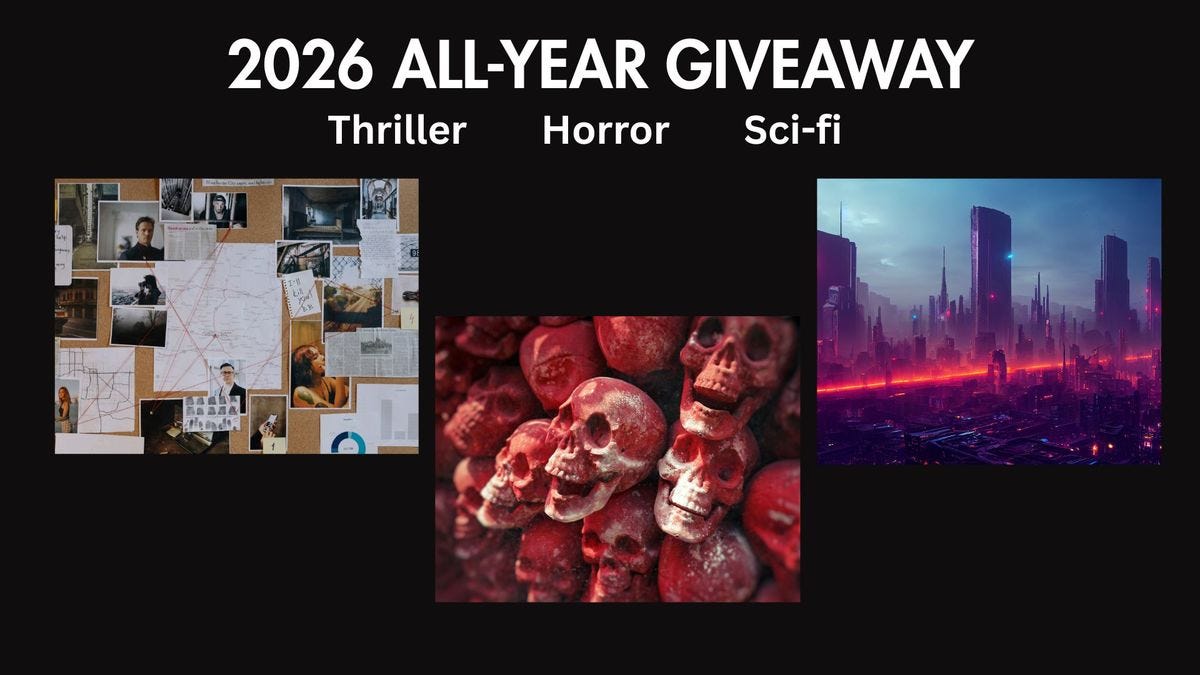
My novelette, An Illicit Mercy, is part of a new promotion this year: 2026 All-Year Giveaway.
Nearly 100 books, excerpts and samples available at no cost!

Cold War Forces Collide to Cover Up an Apocalyptic Future
Get your FREE copy of Glimpse by Daniel P. Douglas
“Five Stars! Daniel P. Douglas offers up a truly entertaining, incredibly thoughtful, wonderfully culminating read as he provokingly teases us with...a Glimpse into our future.” - Readers’ Favorite
In 1950, a small group of agents who will become known as the “Men in Black” deploy in New Mexico to cover up an event that will provide a harrowing glimpse into humanity’s apocalyptic future...
Scientists have cracked open secret alien technology from the wreckage of four crashed flying saucers. They’ve pieced together a device that creates a “glimpse” into future space-time awareness.
Meanwhile, a Russian spy has garnered stolen intelligence about the top-secret technology. But what he doesn’t realize is that a covert government agent is already on his trail.
Cold War forces collide in Farmington, New Mexico. Who will survive, and just what will everyone Glimpse?
by Brian Scott Pauls
Writing a book, I’ve learned, is a lot of work. But there’s a difference between knowing this from an intellectual standpoint and understanding it from experience as I watch the process extend through days, weeks, months, and years.
“So,” you might ask, “why do it at all?”
It’s a question each writer must answer to their own satisfaction. For me, the key lies in my personal relationship to science fiction.
Cloudessy, my consulting business providing fractional Chief Technology Officer services, is a sponsor of this newsletter. If you or someone you know needs professional tech guidance for their author, coaching, or independent publishing business, check out the ad at the end of this post. Thank you!
I first encountered written science fiction in third grade when my brother Steve, four years ahead of me, brought Stanley A. Widney’s “Elevator to the Moon” home from the McPherson Junior High library.1 The cover illustration portrayed two people in spacesuits, one of them beset on all sides by what appeared to be long strips of neon confetti.
Something about the cover engaged my imagination in ways few books had managed previously. Nearly fifty years later, I still remember lying on my stomach in our shared bedroom, reading “Elevator to the Moon,” which I had “borrowed” from Steve—probably when he wasn’t around to object. While most details of the plot have long since slipped my mind, this blurb from Goodreads captures the essence:
“Two men take what they think is an elevator which in reality is a well equipped spacecraft and end up on the moon and encounter ribbon like aliens and have other adventures.”2
Maybe this book wouldn’t stick in my mind if it weren’t for what happened one day when I couldn’t find it. I asked where it had gone, and my mom told me it had reached its due date, necessitating its return. Pleading with her to get it back, I took great affront when she characterized it as too advanced, which implied I hadn’t really been reading it. She told me I needed to stick to books appropriate for my age. This experience seared a minor middle-grade book into my memory.
While “Elevator to the Moon” represents the first step of my science fiction journey, more important steps followed, in which my brother continued to play an instigating role.
The next came a year or two later with a book he brought home from our local public library. And this is a book many readers will recognize—“The Zero Stone” by Andre Norton.3
As with “Elevator to the Moon,” the cover pulled me in. It featured an evocative illustration by Robin Jacques of the two main characters exploring a wrecked ship in space.4
Goodreads describes the story as follows:
“Murdoc finds phenomenal powers in the stone ring that he inherits from his father but only comes to understand those powers completely through contact with an interplanetary wanderer in the form of a feline mutant.”5
Here, more of the characters and events have stuck with me over the years—a tribute to Norton’s abilities as a storyteller. She knew her audience well. Her main character is young, still learning his trade, and Norton reveals a lot about his home life before he accepts an apprenticeship with a gem merchant. She portrays his close relationship with his father, as well as his strained relationships with his mother and brother. While not my experience, these elements provided enough familiar touch-points to make Murdoc real to me. And the plot moves fast—first in the city where we meet him and then across the stars to a wilderness planet full of danger and adventure. I loved it.
What I didn’t know was that “Andre Norton” was a woman. She intended this, of course, adopting the name in 1934 for her first book, ‘The Prince Commands,’ to better sell her work in a market targeted at boys—and legally changing her name to Andre Alice Norton that same year.6 Looking back, the book must have had an “About the Author” page, but if so, I didn’t read that part. It would be another two or three years until a junior high classmate sagely informed me, “Andre Norton is a man.” This revelation taught me to be careful of my assumptions about writer identities. It also served as a basis for later understanding the importance of representation in a commercial field that can be unfair to some participants.
But more discoveries awaited me.
My introduction to Isaac Asimov likely occurred as part of an annual tradition in my hometown. Each year, the school children of communities in McPherson County get the first or second Friday of May off for “All Schools Day,” a celebration centered on a large parade down McPherson’s Main Street.7 It also involves several activities following the parade. I don’t know if this tradition has continued, but as a kid, I always hit up the used book sale in the gymnasium of the Community Building. The size of this event impressed me. A rectangle of long tables around the perimeter of the gym held stack after stack of books, fiction and nonfiction. I most likely acquired my paperback edition of “Foundation” from one of these stacks.8
This started me on what I’ll call my “Asimov Period,” when I read as much of his science fiction as I could find, including “The Stars, Like Dust,” the first book I ever bought for myself (and the second book in what would come to be known as his Galactic Empire series.)9 It also introduced me to Asimov’s famous robot stories. “I, Robot” may be the first collection of short fiction I thoroughly enjoyed.10 I also appreciated how, as a trained scientist, he strove to make his stories scientifically plausible.11
During this same period, my brother built up a small library of his own, largely consisting of books acquired at the same used book sale. This library contained several works of science fiction, one of these being “Rocket Ship Galileo” by Robert A. Heinlein. I have since learned that this represents Heinlein’s earliest juvenile work and that many regard it as his worst.12 That may be, but I considered it gripping then, and still do today. As a ten- or eleven-year-old boy, I found the story about teenagers building their own atomic rocket ship (granted, with the help of an indispensable, skilled, and well-connected adult) grand entertainment. While not a scientist, Heinlein trained in engineering at the U.S. Naval Academy.13 His writing reflects this field’s rigor for accuracy, complementing Asimov’s, and giving the story an air of verisimilitude. And it’s a testament to his skill as a writer that even in one of his weaker novels, he still establishes the trope of “Escaped Nazis on the Moon” for future writers to explore.14
This began my “Heinlein Period.” While it may have overlapped with my “Asimov Period,” it lasted longer—basically until I ran out of Heinlein to read. I found his Future History collection “The Past Through Tomorrow” quite inspirational. It includes many short stories and even a short novel.15 I’m using its structure as a model for “Probability Amplitudes.”
All these sources contributed to my love of science fiction, and as a result, my drive to write a science fiction book of my own. Widney provided the initial spark. Norton introduced me to the joy of planetary and interstellar adventure. Asimov and Heinlein taught me to value short fiction and scientific accuracy. But my growing awareness of the science fiction community may have been an even stronger motivation. As I learned about various authors, their books, and the connections they created between many of their stories, I realized that in the background lay a web of connections between writers who were also often the editors and publishers of one another’s work. I longed to be part of that community. Even as I imagined becoming an astronaut, as many kids do, I also harbored the ambition of becoming a science fiction writer.
I didn’t pursue this dream for many years. I used the excuse that I needed a well-paying job before I could take time to write. Or that I needed to acquire age and experience before I would have anything important to say. Or that the chances of getting published were too slim.
All these excuses had the same source—fear. On some level, I knew I’d suffered my whole life from a crippling fear of rejection. But I didn’t know why.
In time, I became a technician in the science-fiction-adjacent computer industry, then the owner of a computer support company. While this kept me busy and fed my interest in computers, it never fully satisfied me. I still had a hidden problem, an obstacle that prevented me from even trying to pursue my dreams.
It took a marriage to a loving and highly skilled social worker, building a family, a lot of desperation, and honest self-assessment before I recognized, confronted, and addressed what was really wrong. I don’t have the space here to tell the full story. And some of it may be too personal for me to share with the public. But I can share the problem itself. Doing so will be helpful to me, and perhaps to others.
My chronic fear would often manifest as hypochondria. I spent a year or more of college in crippling fear that I’d contracted HIV, even though I didn’t fall into a high-risk group and largely avoided even lower-risk behaviors associated with infection. But this single health condition didn’t comprise the limit of my fears. Any lump, any place on my body, might be a sign of cancer. I tried to laugh this off with comments to others like, “Maybe I have foot cancer.” But this was bravado. In truth, I needed to say something instead of keeping the fear inside, where it would eat away at me. After marrying my wife, she gave me the wise suggestion that, not being a doctor or a scientist, I stop scouring full medical studies online. This turned out to be a relief as the practice exacerbated my concern rather than alleviating it.
But my fears extended beyond hypochondria, to social anxiety (especially regarding interaction with women) fear of getting fired (and I got fired a lot before starting my computer business) and fear of going to hell (a contribution from certain childhood evangelical Sunday School teachers in my largely quite wholesome Mennonite tradition.)
Still, hypochondria led me to an answer. One night, I found myself awake in bed, far too late into the night, worrying about an unlikely medical concern I can’t even remember. I knew it to be unlikely and told myself so. Then, the question occurred to me—could I have Obsessive Compulsive Disorder? Of course, I grabbed my phone from my nightstand and Googled OCD. I remember thinking, “This is what Nikki told me not to do.” But I felt I was on to something.
I didn’t find a medical study, but a description of OCD, so close to my experience, it couldn’t be coincidence.
Soon after, I sat in my doctor’s office, explaining 35 years of struggle. When I’d finished, he said,
“Well, I’m no psychologist, but based on your symptoms, I don’t have a problem diagnosing you with a pretty severe case of OCD.” I walked out with an SSRI prescription, which has made my symptoms manageable for the past six years.
If you’re wondering what all this has to do with my book, the first activity I took up after getting my OCD under control was writing science fiction. I wrote my first short story in years. Then, I wrote another, for a competition on Wattpad—and won. A few stories later, I thought maybe I could sell my writing. I began listening to self-publishing podcasts, and within a few years, I started this newsletter.
So why go to all this trouble? Because I’ve wanted to be a science fiction writer since I was a kid. Widney, Norton, Asimov, and Heinlein instilled this desire in me at an early age. I allowed a mental health condition to stop me for a long, long time. But that condition is under control at last. This is my opportunity to surpass the limitations that hemmed me in all those years. I’m going to take it.
Do you face mental health challenges you’d feel comfortable sharing? Please comment below!
Artificial intelligence tools performed multiple tasks in the creation and publication of this article.

This month, I’m sharing my thoughts about B. L. Blanchard’s Sidewise Award-winning novel The Peacekeeper on Club Codex, where any Cosmic Codex subscriber can follow along, comment, or ask questions.
Here’s my latest comment in the discussion thread:
”I found the following highlight evocative:
’Without dreams, he could only access part of the knowledge he needed to make good decisions for himself and his sister. It was like part of his soul had been amputated, and what remained was bloody and exposed.’
This seems like a good characterization of where Chibenashi is at, following the second murder.”
Click below to participate:

Authors: Turn Tech Chaos Into Calm, Clear Systems
Your email platform doesn’t talk to your course host. Your CRM doesn’t connect to your payment processor. And somewhere in that gap, you’re losing sales you’ll never be able to trace.
Tech chaos is one of the most common—and costly—problems facing author businesses today. According to a study from Slack, the average business owner loses up to 96 minutes of productivity every single day to fragmented tools. That’s three full weeks of wasted time per year.
Cloudessy’s fractional CTO services can help authors, coaches, and independent publishers simplify your tech stacks, prevent launch failures, and build systems that actually support growth.
Ready to stop fighting your tech?

Stanley A. Widney, Elevator to the Moon (New York: Follett Publishing Company, 1955), 128 pp., illustrated by Earle Goodenow; see the ISFDB title record and the SF Encyclopedia entry on Widney, which describes it as a spoofish young-adult adventure in which an elevator boy is accidentally lifted to the Moon.
Goodreads entry for Elevator to the Moon by Stanley A. Widney, accessed October 17, 2026. Spelling and punctuation as on the site.
Andre Norton, The Zero Stone (New York: The Viking Press, 1968), the first of the two Murdoc Jern novels; its sequel is Uncharted Stars (Viking, 1969). See the ISFDB title record.
The cover art of the Viking first edition is credited to Robin Jacques in the SF Encyclopedia checklist for Norton, which also credits Jacques with the cover of Uncharted Stars.
Goodreads entry for The Zero Stone by Andre Norton, accessed October 17, 2026. ISFDB records the same text as the publisher’s description.
Born Alice Mary Norton, she adopted the name Andre for her first book, The Prince Commands (Appleton-Century, 1934), and legally changed her name to Andre Alice Norton the same year. The Encyclopedia of Cleveland History reports that the publisher warned her name and gender would put off the young male readers the book was aimed at; the SF Encyclopedia calls Andre “initially the working name… but for most of her career her legal name”; the Contemporary Authors entry dates the legal change to 1934; and Wikipedia gives the full legal name.
McPherson County All Schools Day began in 1914 as a countywide celebration for eighth-grade graduates; the parade runs down Main Street on the second Friday in May. See the event’s history page and parade page.
Isaac Asimov, Foundation (New York: Gnome Press, 1951), a fix-up of stories first published in Astounding between May 1942 and October 1944; see the ISFDB title record and the SF Encyclopedia. Paperback editions followed from Ace (abridged as The 1,000 Year Plan, 1955) and Avon (from 1966).
Isaac Asimov, The Stars, Like Dust (Garden City, NY: Doubleday, 1951), first serialized as “Tyrann” in Galaxy, January–March 1951; see the SF Encyclopedia. Published second of the three Galactic Empire novels, after Pebble in the Sky (1950), it is the earliest in the sequence’s internal chronology; see Wikipedia for the narrative order.
Isaac Asimov, I, Robot (New York: Gnome Press, 1950), a collection of nine linked stories first published in Super Science Stories and Astounding between 1940 and 1950, beginning with “Strange Playfellow” (Super Science Stories, September 1940; retitled “Robbie”); see the SF Encyclopedia and Wikipedia for the contents.
Asimov took his PhD in chemistry at Columbia in 1948 and joined Boston University School of Medicine in 1949, rising to associate professor of biochemistry; he left the position in 1958 and became a full-time writer. See the SF Encyclopedia and, for the degree, Wikipedia.
Robert A. Heinlein, Rocket Ship Galileo (New York: Charles Scribner’s Sons, 1947), the first of his Scribner’s juveniles. The SF Encyclopedia calls it “Unremarkable in itself,” and Jo Walton’s Reactor reread opens by conceding it is the weakest of the juveniles.
Heinlein graduated from the U.S. Naval Academy at Annapolis in 1929 with the equivalent of a bachelor of arts in engineering; he served five years as a naval officer before leaving the service for ill health in 1934, and spent World War II as an engineer at the Naval Air Experimental Station in Philadelphia. See the SF Encyclopedia and, for the Annapolis degree, Wikipedia.
The SF Encyclopedia’s entry on Iron Sky identifies Rocket Ship Galileo as probably the first SF story in which Nazis escape into space after World War II. “Probably” is the encyclopedia’s hedge, and I’d welcome an earlier example if a reader knows one.
Robert A. Heinlein, The Past Through Tomorrow (New York: G. P. Putnam’s Sons, 1967), collecting the Future History stories from The Man Who Sold the Moon, The Green Hills of Earth, and Revolt in 2100 (omitting only “Let There Be Light”), plus “The Menace from Earth,” “Searchlight,” and the novel Methuselah’s Children (Astounding, July–September 1941; rev. 1958); see the SF Encyclopedia for publication history and Wikipedia for the contents.


