


My novelette, An Illicit Mercy, is part of a new promotion in September and October: Free Sci-Fi, Fantasy, & Paranormal.
Over 60 books available at no cost!
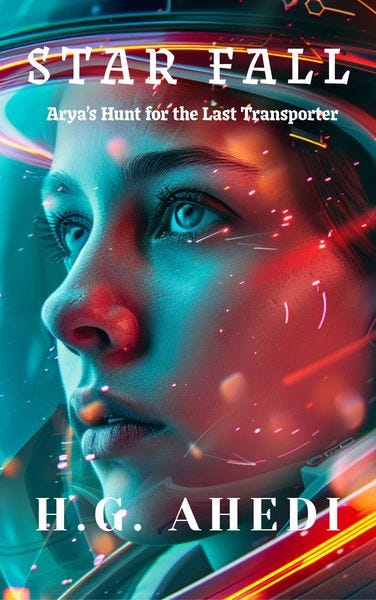
History remembers heroes. History forgets what heroes buried.
Get your copy of Star Fall by H. G. Ahedi!
On the planet Terranox, a lethal mining poison is killing Arydians one by one. Arya Weld, a young mechanic, has one mission: find the Starfall, the ship that vanished with her mother. To get closer, she risks everything to win a deadly race — only to discover she’s infected, and running out of time.
With the clock ticking, Arya joins hands with a resourceful broker and assembles a crew, launching the Remnant in the direction Starfall was last seen. Arya knows this is a one-way ticket. What she doesn’t know is that, by leaving the system, she’s awakening a threat that has waited centuries to return.
by Brian Scott Pauls
Children of Ruin is the strongest book in Adrian Tchaikovsky’s original Children of Time trilogy. Last month, I critiqued the first novel, in which he explores the development of jumping spiders into an intelligent species across thousands of years—and what happens when they encounter humanity. Children of Ruin keeps to the eight-appendage theme by tackling octopuses.
Tchaikovsky published Children of Ruin in May 2019, four years after Children of Time.1 It won the British Science Fiction Association Award for Best Novel of 2019.2 I’ll review the third volume, Children of Memory, next month.
Cloudessy, my consulting business providing fractional Chief Technology Officer services, is a sponsor of this newsletter. If you or someone you know needs professional tech guidance for their author, coaching, or independent publishing business, check out the ad at the end of this post. Thank you!
Emulating its predecessor, Children of Ruin jumps (like a spider!) between two time frames.3 In the “past,” an Old Empire terraforming crew arrives at a distant system, finding a life-bearing world they name Nod. It possesses a biochemistry built on elements hazardous to humans and organic molecules evolution never produced on Earth.4 Mission commander Yusuf Baltiel stays to study Nod, but his eccentric colleague Disra Senkovi takes the terraforming equipment to the system’s ocean world, Damascus, along with a tank of octopuses and a supply of the same nanovirus that, light-years away, is busy uplifting the Portiids from Children of Time.5
Thousands of years later, in the “present,” we encounter an expedition of the spider-like Portiids, accompanied by “Humans” (as Tchaikxovsky styles the humans modified to co-exist with them6). Aboard the Voyager—with the uploaded, much-altered Avrana Kern along as ship’s mind—the crew follows fragmentary radio signals to the same system, hoping to find lost cousins.7 What they find instead is a spacefaring octopus civilization in the middle of a catastrophe above a quarantined planet.
Like the spiders in Children of Time, Tchaikovsky’s portrayal of the octopuses benefits from his strong grasp of evolutionary biology.8 For insight into cephalopods, he credits Peter Godfrey-Smith’s 2016 book, Other Minds, in the acknowledgements as “an invaluable research aid.”9
Cephalopods are a good choice for this second book. Our last common ancestor with the octopus lived some 600 million years ago, and was probably a flattened worm a few millimeters long. From that point, cephalopods followed a completely separate evolutionary track to a surprising intelligence.10 Dispersed nervous systems, with more than half of their roughly 500 million neurons in their arms rather than their heads, provide octopuses with something closer to mental committees than our compact, unified brains.11
Tchaikovsky’s octopus characters exhibit a vocabulary describing this very different neurology. “The Crown sets strategy, but battlefield tactics are the province of the Reach, those sub-nodes that run the arms.”12 An octopus fights with its whole body, even aboard a spaceship: “her skin sings a furious hymn of battle and her arms calculate vectors and suggest firing solutions.”13
Tchaikovsky derives a psychology from these creatures’ physiology, and a society from that psychology. Octopuses communicate in color with their skin, and in posture with their arms and the rest of their body.14 Their discourse carries far more mood and subtext than hard information.15 And a creature with no fixed body plan has no fixed convictions: the octopuses “hold no certainties” and don’t “let themselves be ruled by tradition or history or even how they themselves felt yesterday.”16
The octopuses reflect real-life biology, but the life on Nod is brilliant speculation.
At first, Baltiel’s scientists don’t recognize what they’ve found. When a crew member falls ill, a colleague insists nothing native could be responsible; Earth life is too different from Nodan life, and “[p]arasites are the most specialized of specialists!”17 They evolve to thrive within very specific environments, which could in no way resemble the human body. She is right about Earth and catastrophically wrong about Nod. The terraformers have disturbed a colonial organism whose cells encode and share memory, “microscopic cells trading encoded understandings like Earth bacteria exchange immunity genes.”18 It learns whatever it absorbs, and it is very, very curious.
The organism, as the book calls it, isn’t a villain in the classic sense. It’s a mind with a different evolutionary history, which can infect and hijack the nervous system of any potential host it encounters.19 Having never met anything it could not become, the organism has no concept of a boundary between itself and the rest of the universe. Every infection is, from its perspective, an act of friendship.20 Kern, the only character in the story with the experience to grasp the organism’s nature, sums up the challenge of trying to fight it: “I do not believe it would be possible to impose controls on it that it could not circumvent or subvert.”21
This ability to hijack human minds raises the question of what it means for the compromised individuals.22 As the Portiid scientist Fabian wonders regarding the hijacked human Lante: “Was there a Lante, at the end, and was she aware of what she had become?”23 Kern, who has herself been human, hybrid, program, and ant colony in turn,24 knows the uploaded Lante exists only when the organism consults her, then is “gone like a blown candle until the organism wants her again...”25
Still, amid these travails, Tchaikovsky weaves a thread of hope. Yes, he subtly insists, minds shaped by different evolutionary histories will find one another profoundly difficult to comprehend. But there will always remain a realm of experience common to all intelligent life. And while it may be narrow, this shared territory provides the foundation for mutual understanding and cooperation.
Tchaikovsky highlights the philosophical concepts at issue here. The Human and Portiid linguists confront Thomas Nagel’s problem directly, building tools “so that the anthropoid brain can grasp what it is like to be a spider,”26 and asking whether the two kinds of experience are “intrinsically incompatible.”27 Senkovi, uplifting his octopuses millennia earlier, encounters Wittgenstein’s conundrum: “If a lion could speak, as the man said, we could not understand it.”28 The Human Helena, negotiating with the Damascans while they hold her prisoner, catches herself relying on “anthropomorphism as a yardstick of what alien minds can conceive...”29
Tchaikovsky deftly orchestrates instances of contact between his various species. When the octopus Paul suddenly realizes Helena is grieving as he himself might, “It makes Paul think of the creature as a fellow living thing in a way he hadn’t before.”30 The Portiid scientist Viola, confronted with evidence of the organism’s consciousness, concludes: “‘Convergent evolution. Perhaps it is something that any life would attain, eventually.’”31 The novel proposes that happiness, sadness, and the feeling of home are each “another commonality between species.”32 In Children of Ruin, Tchaikovsky posits that if life developed consciousness on Earth, it can develop it elsewhere. And he believes that when we encounter it, we will be able to recognize it and find “siblinghood” with it, as unusual as it may be.33
The biggest weakness of Children of Ruin is its structure.
Children of Time asks us to follow two storylines across thousands of years and maintains continuity with the elegant trick of recurring Portiid names. Children of Ruin also presents a pair of storylines, but increases the size of the cast. The plotline set in the past gives us Baltiel, Senkovi, Lortisse, and Lante. The present has Helena, Portia, Meshner, Fabian, Viola, and Kern, plus a rotating slate of octopuses—Paul, Solomon, Lot, Noah, Ruth, Abigail, and Ahab. The octopuses’ recurring Biblical names, like the Portiids’ names before them, indicate each represents multiple individuals across generations.
In addition, the human characters are more numerous than in Children of Time, and spread across a longer period, making it harder for them to serve as the backbone of the overall plot.
Despite these flaws, Tchaikovsky’s deep exploration of the problem of other minds, from multiple directions, makes Children of Ruin a better novel than the already good Children of Time. The Damascan civilization stands beside the Portiids as one of the most convincing non-human societies in recent science fiction, and the Nodan organism is a notable creation of scientific speculation.
Recommended for: Readers of hard science fiction who want truly non-human aliens, and anyone who has read and enjoyed Godfrey-Smith’s Other Minds.
Not recommended for: Readers who need one protagonist to follow through a story, or who didn’t appreciate the jumping back-and-forth between eras in Children of Time.
Thoughts about Children of Ruin? Please comment below!
Artificial intelligence tools performed multiple tasks in the creation and publication of this article.
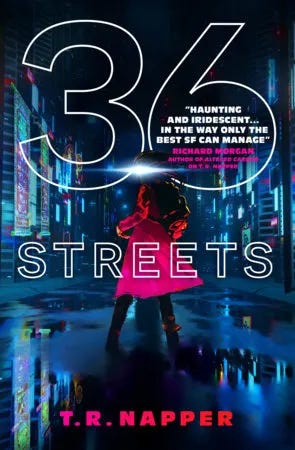
This month, I’m sharing my thoughts about T. R. Napper’s Aurealis Award-winning novel 36 Streets on Club Codex, where any Cosmic Codex subscriber can follow along, comment, or ask questions.
One of my favorite passages from the last quarter of the book:
“‘…real or unreal makes no difference, as either is of equal power in manufacturing the person you are.”
Click below to participate:

Authors: Turn Tech Chaos Into Calm, Clear Systems
Your email platform doesn’t talk to your course host. Your CRM doesn’t connect to your payment processor. And somewhere in that gap, you’re losing sales you’ll never be able to trace.
Tech chaos is one of the most common—and costly—problems facing author businesses today. According to a study from Slack, the average business owner loses up to 96 minutes of productivity every single day to fragmented tools. That’s three full weeks of wasted time per year.
Cloudessy’s fractional CTO services can help authors, coaches, and independent publishers simplify your tech stacks, prevent launch failures, and build systems that actually support growth.
Ready to stop fighting your tech?

"New Books: 14 May 2019," Locus, May 14, 2019, https://locusmag.com/2019/05/new-books-14-may-2019/; "Children of Ruin," Wikipedia, accessed September 26, 2026, https://en.wikipedia.org/wiki/Children_of_Ruin.
"2019 BSFA Awards Winners," Locus, May 2020, https://locusmag.com/2020/05/2019-bsfa-winners/.
Plot particulars follow "Children of Ruin," Wikipedia, and Gerry Canavan, "We Are Going on an Adventure: On Adrian Tchaikovsky's 'Children of Ruin,'" Los Angeles Review of Books, June 29, 2019, https://lareviewofbooks.org/article/we-are-going-on-an-adventure-on-adrian-tchaikovskys-children-of-ruin/.
Adrian Tchaikovsky, Children of Ruin (Orbit, 2019), 137.
"Children of Ruin," Wikipedia.
Tchaikovsky, Children of Ruin, 279.
"Children of Ruin," Wikipedia.
"Adrian Tchaikovsky," Wikipedia, accessed September 27, 2026, https://en.wikipedia.org/wiki/Adrian_Tchaikovsky.
Tchaikovsky, Children of Ruin, Acknowledgements.
Peter Godfrey-Smith, Other Minds: The Octopus, the Sea, and the Deep Origins of Consciousness (New York: Farrar, Straus and Giroux, 2016), 5–9. On the roughly 600-million-year divergence, see also Steven Rose, "Other Minds: The Octopus and the Evolution of Intelligent Life, by Peter Godfrey-Smith," Times Higher Education, March 23, 2017, https://www.timeshighereducation.com/books/review-other-minds-godfrey-smith-william-collins.
Godfrey-Smith, Other Minds, 50; Alvin Powell, "Thinking Like an Octopus," Harvard Gazette, October 21, 2010, https://news.harvard.edu/gazette/story/2010/10/thinking-like-an-octopus/, reporting Godfrey-Smith's figure of roughly 500 million neurons, more than half in the arms.
Tchaikovsky, Children of Ruin, 141.
Ibid., 386.
Godfrey-Smith, Other Minds, 110–12, 130–31.
Tchaikovsky, Children of Ruin, 247–48.
Ibid., 385.
Ibid., 242.
Ibid., 548.
Ibid., 505–6.
Ibid., 522; see also 541.
Ibid., 505–6.
Ibid., 487.
Ibid., 486.
Ibid., 165.
Ibid., 528.
Ibid., 92. Thomas Nagel, "What Is It Like to Be a Bat?," The Philosophical Review 83, no. 4 (1974): 435–50, https://www.jstor.org/stable/2183914.
Tchaikovsky, Children of Ruin, 101.
Ibid., 225. "If a lion could talk, we could not understand him": Ludwig Wittgenstein, Philosophical Investigations, trans. G. E. M. Anscombe (Oxford: Blackwell, 1953), pt. II, sec. xi.
Tchaikovsky, Children of Ruin, 422.
Ibid., 417.
Ibid., 486.
Ibid., 516; see also 303–4.
Ibid., 190; see also 486, 516.


