


My novelette, An Illicit Mercy, is part of a new promotion in September and October: Free Sci-Fi, Fantasy, & Paranormal.
Over 60 books available at no cost!
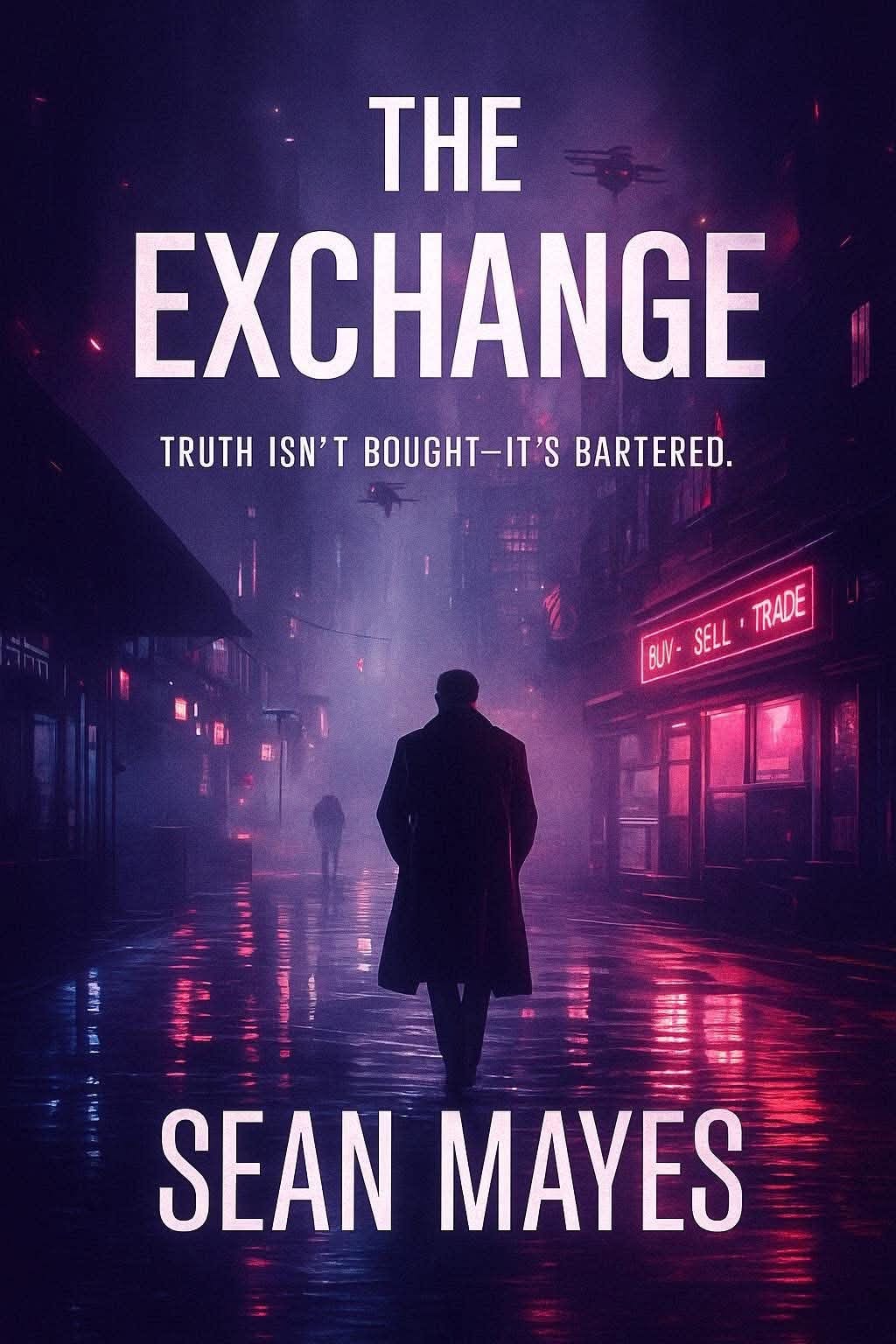
Get your copy of The Exchange by Sean Mayes!
In a neon-lit future where memories have become currency, a hidden shop offers people an impossible opportunity: the chance to buy an experience they never had, sell a moment they can no longer bear, or trade part of themselves for something they desperately want.
Behind the counter stands the enigmatic Vendor who never pressures his customers and never lies about the price. Through five interconnected stories, ordinary people enter the Exchange carrying grief, ambition, guilt, curiosity, and regret. Each believes surrendering a memory might free them—or that purchasing one might finally fill what is missing.
But memories are more than records of the past. They shape identity, relationships, and truth. Once a memory is traded away, the consequences can reach far beyond the person who surrendered it.
The Exchange is a speculative-fiction anthology about temptation, loss, and the dangerous human desire to escape ourselves. It asks one unsettling question:
If everything inside you had a price, what would you be willing to trade?
by Brian Scott Pauls
In 2023, with regard to Probability Amplitudes (my first science fiction collection), I shared my “intention to produce the highest quality work possible.” But I didn’t discuss what this might look like, beyond “[r]ounds of editing (by an experienced editor, not by me)” following “alpha- and beta-reading.”
In the intervening three years I’ve acquired numerous tools, both physical and virtual, to make this job easier and less expensive—while letting me get the most out of paid, professional editing.
Of course, the larger the number of tools, the easier it becomes for the editing process to get out-of-hand. To avoid this, I recently used Claude to create an editing/publishing outline, indicating where each tool best fits (based on Claude’s training data, as this is a subject beyond my own expertise).
At this time, the process includes 14 separate tools, ranging from a method for creating character attributes that don’t all conform to my own biases (using the Dungeons & Dragons character generation system from the Moldvay Basic rules) to multiple software editing tools (AutoCrit, Hemingway, and ProWritingAid) to three different card decks—one each for story-building, character motivation, and self-editing (Sefirot Fabula, intùiti, and Edito, respectively). While complex, the purpose of this process is to allow me to put my best work in front of both editors and readers.
I’m sharing the tool list and resulting outline for those readers and fellow writers who might find it helpful. It’s unlikely a large number of authors will want to use exactly the same tools, in exactly the same way. But perhaps what I’m doing will prove instructive for those who might want to create something similar for themselves.
Tools
Below are the tools I’ve chosen to incorporate into my process. Each is listed by name, the part of the process it addresses, and the format (website, software, card deck, etc.).
AutoCrit: Dialogue ratio, adverb frequency, and pacing markers, compared with published work in the genre (website)
Claude: Text indexing and search, streamlining work with Sefirot Edito (q.v.; artificial intelligence)
CritiqueMatch: Critique partners and beta readers (website)
Critters: Critique community (website)
D&D Moldvay Basic: Characteristic generation, randomized to provide a variety of character types (ebook)
Dialogue Doctor: Dialogue-based character design and growth (worksheet and ebook)
Hemingway: Sentence length, adverbs, passive voice, and readability (website/software)
Mind Prober: Personality profiling (software)1
ProWritingAid: Line editing, grammar, and consistency (software)
Scrivener: Word processor with character sketch templates (software)
Sefirot Edito: Self-editing (card deck)
Sefirot Fabula: Story-building (card deck)
Sefirot intùiti: Character motivation (card deck)
SFF Online Writing Workshop: Critique partners and possible professional review (website)
Editing Process: Mixed-Length Collection (Self-Published)
Flash fiction through short novel, with interstitial notes
Legend: 🔴 Required · 🟡 Preferred · ⚪ Self-directed
THE CHARACTER CHAIN
Six steps, each feeding into the next.
CC1. Character Generation (D&D: Moldvay Basic) — generate physical and mental baselines. Unexpected outcomes can produce opportunities (e.g., a high-Charisma, low-Wisdom result creates an interesting dynamic). Remember that six numbers describe a character’s capability, not who they are as a person.
CC2. Personality Profile (Mind Prober) — build the character’s personality and psychology on top of CC1.
CC3. Neuro-Variance — for each important character, pick a mental health category where they sit outside the expected range. Don’t treat this as a diagnosis. Use it to push the character in surprising directions. Guard against stereotyping; clinical categories make it tempting. Give the character a tendency that creates an obstacle to something they want.
CC4. Sefirot intùiti — derive drives, motivations, and hang-ups from CC1–CC3.
CC5. Scrivener Character Sketch — consolidate. Come back to this document while drafting.
CC6. Character Voice/Growth Worksheet (Dialogue Doctor) — Five voice components, the character’s growth arc, and a list of important scenes based on these elements.
Dialogue Doctor vs. Sefirot Fabula — CC6’s scene list and Fabula’s HERO’S DEVELOPMENT cards answer the same questions. Run CC6 first, then import its scenes into Fabula. Reversing this can cause Fabula’s archetypes to pull the character toward generic qualities instead of letting Dialogue Doctor differentiate them.
Sefirot Edito vs. AutoCrit — Edito prompts while AutoCrit measures. Edito’s cards ask whether a scene belongs in the story; AutoCrit counts dialogue ratio, adverb frequency, and pacing markers, then compares them against published work in the genre to supply outside perspective. Where the two overlap regarding pacing, follow Edito’s process, referring to the AutoCrit report for clarification when a pacing problem is suspected but not obvious.
PART ONE — PER-PIECE LOOPS
TRACK A — Flash (under ~1,500 words)
A1. ⚪ Premise — use Fabula: ASSETS if it helps.
A2. ⚪ Character check — skip the character chain. Run CC6’s five voice components alone as a one-minute distinctness test.
A3. ⚪ First Draft — draft in one sitting where possible.
A4. ⚪ Drawer time — leave it a day or two.
A5. ⚪ Revise and read aloud — at this length, merge these two steps. Run ProWritingAid Chapter Critique.
A6. 🔴 Critique reader — or SFF Online Writing Workshop (OWW)/CritiqueMatch/Critters.
A7. ⚪ Final pass — run ProWritingAid and Hemingway.
TRACK B — Short story (~1,500–7,500 words)
B1. ⚪ Premise — use Fabula: ASSETS selectively.
B2. ⚪ Character chain — run full CC1–CC6 for the lead. Run CC1, CC2, CC5 for anyone else who matters. Keep the arc section light — many short stories turn on a change of understanding, not behavior.
B3. ⚪ Minimal planning — build the CC6 scene list, then import into Fabula: CHARACTERS and EDITING cards if non-linear.
B4. ⚪ First Draft
B5. ⚪ Drawer time — leave it days to two weeks.
B6. ⚪ Self-revision — run Edito: First revision. Read the whole story in one sitting. Run AutoCrit structural reports: pacing, dialogue ratio, show-vs-tell. Run ProWritingAid Chapter Critique.
B7. 🔴 Critique group — choose OWW for turnaround time and the Editors’ Choice opportunity; choose Critters for a high volume of stories to be critiqued.
B8. ⚪ Revision pass
B9. 🟡 Line edit — spend the most revision effort here. Run Edito: Third revision, ProWritingAid, Hemingway, AutoCrit line-level reports. Check against the CC6 voice components.
B10. ⚪ Read-aloud pass
B11. ⚪ Self copy-edit pre-pass — run ProWritingAid.
TRACK C — Novelette / Novella (~7,500–40,000 words)
C1. ⚪ Premise and research — use Fabula: ASSETS.
C2. ⚪ Character chain — run full CC1–CC6 for protagonist and one antagonist or foil. Run CC1, CC2, CC5 for the rest.
C3. ⚪ Outlining — import CC6 scenes into Fabula: full HERO’S DEVELOPMENT. Use EDITING cards for sequencing.
C4. ⚪ First Draft
C5. ⚪ Drawer time — leave it weeks to months.
C6. ⚪ Self-revision — run Edito: First revision. Address plot, character arc, structure, setting. Run AutoCrit structural reports. Run ProWritingAid Manuscript Analysis.
C7. ⚪ Revision pass — run Edito: To Do / Thoughts / Done.
C8. 🟡 Content pass — run Edito: Second revision. Read aloud chapter by chapter for pacing.
C9. ⚪ Revision pass
C10. 🔴 Beta readers — recruit readers who will read the full piece and provide feedback. Treat OWW and Critters as supplementary at best; they cap at 7,500 words. Run ProWritingAid Virtual Beta Reader first to catch obvious problems before presenting to beta readers.
C11. ⚪ Beta follow-up revision — re-run AutoCrit structural reports against the beta feedback. When readers report a pacing problem, the reports can help identify the cause in the text.
C12. 🟡 Line edit — run Edito: Third revision, ProWritingAid, Hemingway, AutoCrit line-level reports. Check the CC6 voice components.
C13. ⚪ Read-aloud pass
C14. ⚪ Self copy-edit pre-pass
TRACK D — Short novel (~40,000+ words)
Run the full novel pipeline. This is where the character chain really shines.
D1. ⚪ Premise development and research — use Fabula: ASSETS.
D2. ⚪ Character chain — run full CC1–CC6 for the protagonist and two other arc-bearing characters; that maps onto Fabula’s three CHARACTERS cards. Run CC1, CC2, CC5 for supporting cast. Refer to the CC5 sketches throughout the drafting process.
D3. ⚪ Outlining — build the CC6 scene lists first. Then import them into Fabula: all 18 HERO’S DEVELOPMENT cards, three CHARACTERS cards tracking parallel arcs, EDITING cards for narrative order.
D4. ⚪ First Draft
D5. ⚪ Drawer time — leave it months.
D6. ⚪ Self-revision / second draft — run Edito: Pre-editing, then First revision. Run AutoCrit structural reports for a baseline. Run ProWritingAid Manuscript Analysis.
D7. 🟡 Alpha readers or critique partners
D8. ⚪ Revision pass — run Edito: To Do / Thoughts / Done.
D9. 🟡 Manuscript assessment — get an editorial letter only. Fund this before any other paid stage on this piece.
D10. 🟡 Developmental pass — run Edito: First revision. Assess against Fabula as a diagnostic. Check the CC6 arcs against the text of the draft. Run AutoCrit structural reports and genre comparison. Run ProWritingAid Manuscript Analysis.
D11. ⚪ Revision pass
D12. 🟡 Content pass — run Edito: Second revision. Use Fabula EDITING cards if event order is a problem. Use AutoCrit pacing reports to locate problems Edito reveals.
D13. ⚪ Revision pass — use Edito: mistakes-analysis.
D14. 🔴 Beta readers — recruit novel readers for the full length. Run ProWritingAid Virtual Beta Reader first to catch obvious problems before presenting to beta readers.
D15. ⚪ Beta follow-up revision — re-run AutoCrit structural reports against the beta feedback.
D16. 🟡 Line edit — run Edito: Third revision, ProWritingAid, Hemingway, AutoCrit line-level reports. Check CC6 across all three arcs.
D17. ⚪ Revision pass
D18. ⚪ Read-aloud pass
D19. ⚪ Self copy-edit pre-pass — run ProWritingAid.
All Tracks: Capture real-time origin notes for each story to use later for interstitial material. For a free professional pass, pursue magazine publication for anything in A through C.
PART TWO — ASSEMBLY
⚪ Selection — cut the weak pieces to improve the overall quality of the book.
⚪ Format decision — the novel comprises 25% of the book. Choose between “[Novel Title]: A Novel, with Stories” and a titled collection that contains it. Title choice drives choice of cover, metadata, and categories, as well as how the readers will see the collection as a whole.
⚪ Sequencing — the most important decision of the project. Opening with the novel demands a lot of commitment from readers at the beginning. Closing with it turns everything before it into a long approach. Placing it in the middle splits the book into three parts. Sequence for reading rhythm, not theme. Use Fabula: EDITING cards.
⚪ Thematic coherence — ask what the collection is trying to say, and whether the novel strengthens that case.
⚪ Interstitial strategy — address five concerns before drafting:
Position — headnotes, afterwords, or both?
Register — the author, or a persona? Anecdotal, critical, or minimal?
Scaling — based on story length. A 300-word note is fine before a short story, and absurd before 400 words of flash. Use a brief tag for flash, a standard note for a short story, and a fuller treatment for a novella or the novel.
Function — origin, framing, context, or connective tissue?
Coverage — interstitials for every piece, or only some of them? Skipping flash entirely is legitimate.
⚪ Front and back matter — assemble acknowledgments, prior-publication credits, author note, copyright page. Consider a table of contents with reading times; unusual, but useful with pieces that vary so widely in length.
⚪ Revision pass on selection and order.
PART THREE — INTERSTITIAL DRAFTING
Treat this as nonfiction inside a fiction book. Give it its own loop.
⚪ Draft them all in a tight cluster — written together they cohere. Written piecemeal over months, the voice drifts.
⚪ Drawer time — leave it days.
⚪ Self-revision — check each against the decisions made in step 5. Right tier, right register, is each note doing its job?
🟡 Read-through in book order — read the stories and the notes interleaved, the way a reader would. Expect to discover issues, including whether the differing lengths of various pieces come across as intentional, or just inconsistent.
⚪ Revision pass — watch for two common problems: notes that spoil the piece they introduce, and notes that repeat the point the story already makes.
Use an essayist voice here, distinct from the specific voices of the stories themselves.
PART FOUR — MANUSCRIPT-WIDE EDITING
🔴 Sensitivity / authenticity read — commission one if any piece warrants it. Trigger it specifically when CC3 produced a character who may come across as a caricature of mental illness rather than as a set of interesting traits.
⚪ Revision pass
🟡 Collection-level developmental read — find someone to read all of it at once and provide feedback. Ask whether the novel’s placement works, whether the length variance reads as designed, and whether the interstitial notes help or intrude.
⚪ Revision pass — send a piece back to its track or a note back to step 10 as needed.
🟡 Collection line-edit pass — check voice consistency across pieces written years apart, and the deliberate fiction/interstitial boundary. Compare all the CC5 character sketches with one another — a dozen protagonists run through the same character chain may have converged on similar qualities.
🔴 Copy Edit — hire a professional editor for this before paying for anything else. Build a style sheet across the whole manuscript. Expect the editor to check the novel for continuity and to examine all the stories for consistency across pieces. The interstitials will add potential mistakes of their own: italicized titles, magazine names, dates, publication credits, quoted material. Brief the editor that the book has two registers (the fiction and the interstitials) and four different story lengths (flash, short story, novelette/novella, novel), all intentional.
⚪ Query resolution for the copy edit
⚪ Final Manuscript
PART FIVE — PRODUCTION
⚪ Cover design — 🟡 professional look and feel. It’s the primary sales asset.
⚪ Interior typesetting — handle four structurally different content types: novel chapters, novella chapters, story breaks, and flash pieces. Give the novel a part-title page. Give interstitials their own treatment — distinct, consistent, unambiguous about where each note ends and the relevant piece begins. Specify these details before proceeding with the layout.
🔴 Proofread — proof typeset pages, print and ebook both. Expect a substantial job at this page count. Watch for notes orphaned across breaks, treatment applied inconsistently across tiers, ebook reflow collapsing the distinction, and novel chapter breaks behaving differently from story breaks.
⚪ Final corrections
⚪ Metadata, categories, keywords, blurb — specify the format (short stories and novel), the range (flash fiction to short novel), and the use of interstitials. All three set expectations.
⚪ ARC readers
⚪ Publication
Funding: Copy edit, cover, proofread, collection-level read, then a manuscript assessment on the novel, in that order. The first three separate a self-published book from an obviously self-published one.
Reuse the character chain in multiple steps. During the line edit for each piece, use it as a voice checklist. During the developmental pass of the short novel, check it against the text of the first draft. During the collection line-edit pass, use it to catch too much convergence between characters across different stories.
Thoughts on editing in 2026? Please comment below!
Artificial intelligence tools performed multiple tasks in the creation and publication of this article.
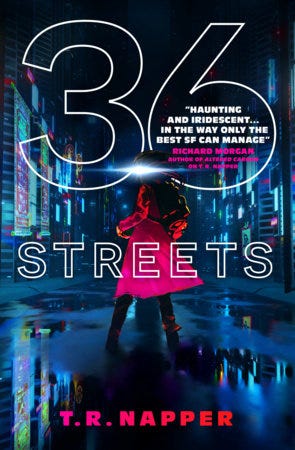
This month, I’m sharing my thoughts about T. R. Napper’s Aurealis Award-winning novel 36 Streets on Club Codex, where any Cosmic Codex subscriber can follow along, comment, or ask questions.
One of my favorite passages from the third quarter of the book:
“’People who feel like they’ve lived long, full lives, do so because they look back on a range of experiences. Exciting, new, different, rich memories that fill up a life. People stuck in an office job, on the other hand, think back and can’t distinguish one day from the next, one year from the next. It all merges into each other. All a blur. The truth is, time flies when you’re bored, doing the same shit, day in day out.’”
Click below to participate:

Authors: Turn Tech Chaos Into Calm, Clear Systems
Your email platform doesn’t talk to your course host. Your CRM doesn’t connect to your payment processor. And somewhere in that gap, you’re losing sales you’ll never be able to trace.
Tech chaos is one of the most common—and costly—problems facing author businesses today. According to a study from Slack, the average business owner loses up to 96 minutes of productivity every single day to fragmented tools. That’s three full weeks of wasted time per year.
Cloudessy’s fractional CTO services can help authors, coaches, and independent publishers simplify your tech stacks, prevent launch failures, and build systems that actually support growth.
Ready to stop fighting your tech?

Posthumous thanks to Damon Knight, who pointed me to this tool in his essay “It All Begins with Characters,” available in the 2021 ebook compilation Faking Out the Reader and It All Begins with Characters from ReAnimus Press.


