My novelette, An Illicit Mercy, is part of a new promotion in October: Free Sci-Fi, Fantasy, & Science Fiction.
Over 150 books available at no cost!
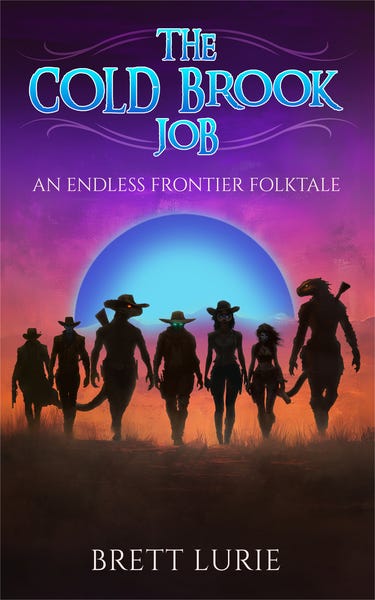
When honor among thieves is broken...
Get your FREE copy of The Cold Brook Job: An Endless Frontier Folktale by Brett Lurie
The infamous Moon Shadow Riders are about to attempt their most daring heist yet. Led by the enigmatic Breylu Dast, this band of outlaws has set their sights on a shipment of platinum. But this job is not just about the money – it is about sending a message to their rival, the ruthless Fraedrik Gor.
With their cyborg leader, a ruthless heavy weapons specialist, a charming duelist, a resourceful hacker, an honorable sniper, a combat medic and an explosives expert who’s one fuse short of a powder keg, the Moon Shadow Riders are ready to take on the world. But will their loyalties remain true if the job goes south?
From high-speed chases on reptilian cybernetic beasts to tense standoffs in smoky saloons, “The Cold Brook Job” delivers a thrilling ride through a science fantasy western landscape where the line between hero and outlaw is as hazy as the desert horizon.
Will the Moon Shadow Riders pull off the heist of the century, or will Cold Brook mark the end of the road for the outlaw gang? Saddle up for a wild adventure where the stakes are high, the action is relentless and the rewards are plentiful!
by Brian Scott Pauls
The following interview occurred September 21, 2026. This transcript has been lightly edited for clarity and length.
Editor’s note: The fifth annual Sturgeon Symposium takes place Thursday and Friday, October 15–16, 2026, at the University of Kansas Hall Center for the Humanities, 900 Sunnyside Avenue, Lawrence, Kansas. Since this interview was recorded, the Gunn Center has announced the winner of the 2026 Theodore Sturgeon Memorial Award: Alex T. Singer, for “We, the Fleet,” published in Clarkesworld in May 2025. Singer will receive the award and read from the story at the ceremony on Thursday, October 15, at 3:30 p.m. Registration and details are at sfcenter.ku.edu.
Brian Pauls: Hello, everyone. I’m happy to have with me today Phil Drake, the director of the Gunn Center for the Study of Science Fiction at the University of Kansas. Welcome, Phil.
Phil Drake: Hello!
Brian Pauls: I really appreciate you taking the time to come on the Cosmic Codex and talk with us a little about science fiction and about the upcoming Sturgeon Symposium. My first question: what is your own background with science fiction, and what inspired you to turn it into not just an interest, but an academic discipline?
Phil Drake: Thanks for inviting me, Brian. That’s a great question, and I took a somewhat unconventional path to science fiction as a scholarly interest. When I was a graduate student, a long time ago, I was very interested in science and technology studies, particularly as they related to environmental issues. As I progressed through my PhD program, I kept returning to science fiction as a way to interrogate, through novel lenses, the practical social, technological, and scientific issues that kept emerging in my applied research. Over time I became increasingly interested in science fiction as a critical lens in its own right.
I happened to be working at the time under John Rieder, a professor at the University of Hawaii who has written several great books on the study of science fiction — particularly its relationship to colonialism, and genre theory — which also animated my interest. So it was a roundabout way in, but science fiction has stayed in my life ever since. At times, professional appointments have pulled me away from it and from being able to teach it, but I’m very fortunate now to be at the University of Kansas, with an opportunity to explore it further.
Brian Pauls: What path brought you to your current position as director of the Gunn Center? And maybe even before that — what is the Gunn Center?
Phil Drake: The Gunn Center for the Study of Science Fiction was started by James Gunn, whom most of your audience probably knows. He was a faculty member at KU for a very long time, and he and his family set up the center to provide substantial support for the study of science fiction, from both a scholarly and a creative standpoint. It has evolved over the years. It has always been housed in the English department and supported by the Gunn family, and its current iteration is focused on programming and on giving undergraduate and graduate students opportunities to develop their interests, whatever they might be, in speculative fiction — science fiction and fantasy, and we’ll even include horror and some other interesting genre fiction in there.
Brian Pauls: Very good. And how did you become the director?
Phil Drake: Some of it stems from my publishing background. I’ve published a couple of articles in Extrapolation, and I’ve worked with the editors of Science Fiction Studies for a long time. But when I came to KU, I never really expected to reignite my scholarly interest in science fiction studies, so it was a real delight to find a very robust community here doing that work.
The way faculty appointments go, openings sometimes appear quite auspiciously. The former director was appointed to a leadership role elsewhere on campus, I was coming out of a leadership role within the department, and our interests aligned. I also had a lot of connections to graduate students, particularly through finding financial support for their research. So it worked out well. The center was already a really nice institution that had been functioning well for several years; my job has been to expand its reach, get more students involved, and maybe develop some more community networking as well.
Brian Pauls: I should take a moment to point out, for some of our younger listeners, that the James Gunn for whom the Gunn Center is named is not the director of the three Guardians of the Galaxy films and other Marvel and DC superhero movies. This James Gunn was a contemporary of the writers of science fiction’s Golden Age — Isaac Asimov, Robert Heinlein, Arthur C. Clarke, Judith Merril, Ray Bradbury — and he used those connections in building the Gunn Center. He wrote science fiction himself, too. I never used to have to make that clarification, but today I feel like I need to.
Phil Drake: He really did a nice job of setting us up with a library where students can come and conduct research. KU’s Spencer Research Library holds some of his really nice things, and I encourage anyone interested to come and visit. You mentioned Bradbury — Gunn’s letters to various famous authors are there, along with work by his students and some of his own drafts. It’s a real treasure trove. I barely know all that’s in there, but we have wonderful librarians who make it accessible.
Brian Pauls: That’s great. I attended one or two of the Campbell Conferences, the predecessor to the Sturgeon Symposium, and it was always fascinating to be there with James leading the discussion. He would suddenly insert an observation from personal experience. One example I’ll always remember: Ted Sturgeon is famous for his maxim, Sturgeon’s Law — “Ninety percent of everything is crap.” Somebody brought that up at a Campbell Conference, and Jim said, “Well, actually, it was ‘ninety percent of everything is crud.’” Then he went on to explain how he’d talked with Ted about it. That happened over and over: these were people he knew personally. I think his biography is called A Life in Science Fiction, and that title is one hundred percent true. [Editor’s note: Gunn’s autobiography is Star-Begotten: A Life Lived in Science Fiction (McFarland, 2017).] It was fascinating to hear those stories secondhand.
But speaking of Ted Sturgeon: one of the events you host is the Sturgeon Symposium, which I think is now in its fifth year. Can you tell us a little about who Ted Sturgeon was, why there’s a symposium named after him, and what its purpose is?
Phil Drake: Ted Sturgeon was a New Age science fiction writer — I’m thinking of him coming out of the ‘60s and ‘70s — who produced an enormous amount of work over the years, in a variety of venues and formats: novels, short stories, TV episodes. He wrote a few episodes of Star Trek. He’s a really interesting writer, and I’ve always viewed him as having a rebellious, critical eye. When I read his work, I always feel there’s an oddness, or a social critique, that’s often very subtle — which is one of the reasons I’ve always been drawn to it. His stories are never straightforward celebrations of technological progress, for instance. There’s a dimensionality to his work that I find really compelling, and his prose is often extremely beautiful. As someone with a literary studies background, I find him an elevated version of science fiction that I can keep going back to. [Editor’s note: Sturgeon’s career began well before the ‘60s. His first science fiction story, “Ether Breather,” appeared in Astounding in September 1939, and he was a central contributor to editor John W. Campbell Jr.’s Golden Age of science fiction. Most of the work for which he is remembered appeared between 1946 and the early 1960s.]1
Every year for the last five years, the Gunn Center has hosted the Sturgeon Symposium: a two-day event of creative readings, scholarly panels, and creative panels on craft — basically, discussing all things science fiction. The symposium is built around the announcement, ceremony, and reception for the Sturgeon Award, which honors the best science fiction short story of the previous year. The winner will be announced very shortly, and they’ll come out to Lawrence, Kansas, to read from their work, receive the award, and hopefully enjoy some of the presentations.
Every year so far, we’ve had a theme. This year’s theme is “Changing Words, Changing Worlds,” inspired by Sturgeon’s short story “Mr. Costello, Hero.” I’m not sure how many of your audience members will know that story, but it’s a kind of how-to guide to building a fascist state. It’s in the line of Fahrenheit 451 or 1984 — great works in which language, and the manipulation of language, results in dramatic seizures of power and control over minds and knowledge. We were inspired by events in the world, and by connecting them to the historical precedents in which these issues have been discussed, although most of the science fiction we’ll be discussing will probably be from the last twenty years or so.
Brian Pauls: The symposium has multiple sessions. If folks are interested in attending, what would be in store for them, and what could they choose from?
Phil Drake: It varies from year to year, but typically the first day includes a couple of virtual sessions, with panelists — often from all over the world — presenting mostly scholarly work on whatever speculative fiction interests them. We try to group them by theme. If you show up in person at the University of Kansas, at the Hall Center for the Humanities, where it’s being held this year, there will be a good range: probably half scholarly panels and half panels dedicated to creative writing and the craft of writing.
We’re not doing this year, but in previous years we’ve had panels on teaching science fiction. Those are always an interesting way to see how faculty in different disciplines — from the hard sciences, to the humanities where I come from, to the social sciences — use science fiction to engage with topics in their own fields. It’s funny: science fiction seems to excite everyone across disciplines, so it tends to be a very vibrant discussion.
In addition to all of that, there’s the awards ceremony on Thursday afternoon. Lunch is served both days, and that can be a fun opportunity to interact with other writers, scholars, and fans of science fiction. It’s open to the community, and registration is about $20, so it’s very cheap. With registration you get a T-shirt, the lunches, and free parking, and it’s usually pretty relaxed. If you’re a student in any program, you can check the student box and attend for free.
This year, on Thursday night, we’ll also have a reading by graduate students of excerpts from their creative science fiction. That will be in downtown Lawrence, and it’s open to the public as well.
Brian Pauls: When you talked about the theme, you touched on the way words — and, by extension, stories — can be used as a means of control, and conversely, I suppose, as a means of liberation. That’s a relevant theme right now. A couple of days ago I was commenting online, because I’d just finished a book by Ray Nayler — he won the Hugo Award a couple of years ago for The Mountain and the Sea. [Editor’s note: Nayler’s debut novel, The Mountain in the Sea (2022), won the 2023 Locus Award for Best First Novel and was a Nebula finalist. His Hugo Award came in 2025, for the novella The Tusks of Extinction.] His new novel, Where the Axe Is Buried, is set in a future world struggling with authoritarian states — very relevant — and it’s also a discussion of how AI might play into that. I was responding to somebody, and it occurred to me to say something to the effect that I wish we lived in a world where science fiction could just be escapism — where we didn’t have reasons for it to be anything else. But it has always served this more important role, going back to the very beginning, and certainly during World War II. It has also been misused from the other side. I wonder whether you have any observations to share, ahead of the symposium, about the role science fiction plays in our world.
Phil Drake: I’m of the belief that all cultural expression provides a kind of trace, or reveals a symptom of broader social conditions. In literary studies that’s a fairly conventional approach, and that’s my background. But I feel that science fiction brings a level of intensity and accessibility to examining those issues.
Take Faulkner, for instance. Faulkner’s lovely — beautiful, literary — but people who aren’t familiar with him, who just pick up a book and don’t have a lot of time to get used to that prose, may struggle. Science fiction typically hooks an audience much more quickly. Often there’s adventure and excitement; often there are very problematic scenes, settings, and themes as well. But it throws social critique in front of a reader — or a viewer, if we’re talking about film — in a way that makes us consider these questions whether we want to or not, and it does so in a delightful way. Thinking about societal change, about how structures and relationships and power operate — these big questions — doesn’t have to feel so elitist and alienating. We can think in practical ways about how science fiction might comment on our lived worlds. As you say, it touches almost everything, so it seems very organic to me to draw on it. In pretty much any class I teach — even when I wasn’t thinking about science fiction as a scholarly field — I’ve always included science fiction texts, just because they’re so vibrant.
Brian Pauls: One thing we’ve seen recently — it’s probably always been there, but certainly since the dawn of the current tech boom, over the last ten or fifteen years — is technologists using science fiction iconography in a way I’m not always one hundred percent comfortable with. I look at someone who names their company or product after a very iconic term from a classic work of science fiction or fantasy, and then I look at what that person is doing with their billions of dollars and their business — I’m not going to identify anyone in particular, and the fact is there’s more than one — and it’s hard not to say to yourself, “Maybe you drew the wrong lesson from those stories, because you seem to be behaving far more like a science fiction villain than a science fiction hero.” There’s probably not much we can do about that. You can name your company whatever you want and run it, within a pretty wide latitude, the way you want. But at least we can be aware of it. So I’m really impressed and excited by the theme you’ve chosen this year. It’s very timely — especially given the way science fiction is being used to drive agendas its authors might not have approved.
Phil Drake: Very much so — thank you. That was the idea: thinking about new social and political developments, some of which are quite old, too, and reminding ourselves that science fiction in particular provides a lot of tools for navigating these problems, imagining possible solutions, and putting things into context. Though it’s hard not to resort to dystopian thinking from time to time, for a lot of reasons.
Brian Pauls: I’ll be at the symposium, and I’m very much looking forward to it. I have a final question before we wrap up, but is there anything else you’d like to bring up about the symposium, or about science fiction in general?
Phil Drake: I’ll give one more pitch: the symposium is meant to be open not only to the KU community, but to the whole community in Lawrence and beyond, including people coming in from Kansas City and the rest of the region. If your audience has a way to get out here easily, it’s definitely worth the time — it’s quite an enjoyable event. There will be some well-established authors talking. If you’re a creative writer, it’s a great way to network and to learn a little more about the thought process of established, successful authors and how they put their work together. It’s also your chance to be exposed to new literature or exciting scholarship in the field, and it’s always fun to get a sense of what we’re doing.
I’m trying to think of other new developments. We do have a book club, which is always fun. If you’re interested in science fiction reading groups, go to our website, sfcenter.ku.edu, where there are all sorts of places to sign up. April is a bit of a slow month on the academic calendar, so last year we decided to celebrate cats in science fiction — April was Science Fiction Cat Month. We’ll probably do something like that again. So we have some goofier events, too, to celebrate and explore the funnier edges of science fiction.
Brian Pauls: Space cats have a long, long history in science fiction, championed most of all by Andre Norton, who had many cats herself.
So, my last question before we wrap up: out of your years of studying science fiction, is there a story — or maybe two or three — that you feel speaks to society in a way that makes it valuable beyond mere entertainment? Or stories you feel should have had a bigger impact than they did, but just aren’t widely known? This is a chance to share the stories you think listeners should know about.
Phil Drake: I’m going to choose one of the most famous novels and talk about it a little, mostly because it’s one of those novels I keep thinking will fade from attention, and it keeps reappearing. Neuromancer feels like a particularly useful text to think through right now. I came to it late — I think I first read it in 2003 or 2004, and at that point it seemed dated. Certainly there are problems of representation, and some clunkiness to the plot that felt a little cringey in spots, but it was still interesting. There’s a whole race, class, and gender dynamic that’s fraught in certain ways but provocative in others, and I think Gibson is pretty smart in what he’s doing.
What’s funny to me is that at the time it felt so out of date, and today it feels almost as if it were written now. Certainly there are cultural differences in technology since it was written in the mid-’80s. But thinking about the AI futures being presented to us, and their possibilities, the foresight Gibson had is pretty extraordinary. And going back to your earlier comment about the ways science fiction influences the people who are changing the world right now, you can clearly see a Neuromancer thread influencing a lot of people. For some reason it’s been in my head. I’m not sure I love that novel, but it’s sticky in my brain, so I keep going back to it.
Brian Pauls: That’s a good pick. I’d say yes, certainly AI — but also the dominance of international corporations, the apparent diminishment of governments, the split in wealth between the ultra-wealthy and a desperate underclass. These are things we’re seeing right now, and I’m not going to disagree with you at all. In fact, I’m on record as saying that of all the possible science fiction futures, the one we got is cyberpunk.
Phil Drake: Yeah.
Brian Pauls: I’m not super happy about it. I would have preferred rockets to Jupiter, but we are where we are.
Well, Phil, thank you so much for coming on. I second what you said: if you’re in the area, definitely come down and check out the Sturgeon Symposium, and if you can join some of the virtual sessions, I think it would be worthwhile. Thank you, and thanks to the Gunn Center, for keeping this tradition alive at the University of Kansas.
Phil Drake: Thank you.
Brian Pauls: All right — thanks, everyone, and I’ll talk to you next week on the Cosmic Codex!
Thoughts on my interview with Phil Drake? Please comment below!
Artificial intelligence tools performed multiple tasks in the creation and publication of this article.
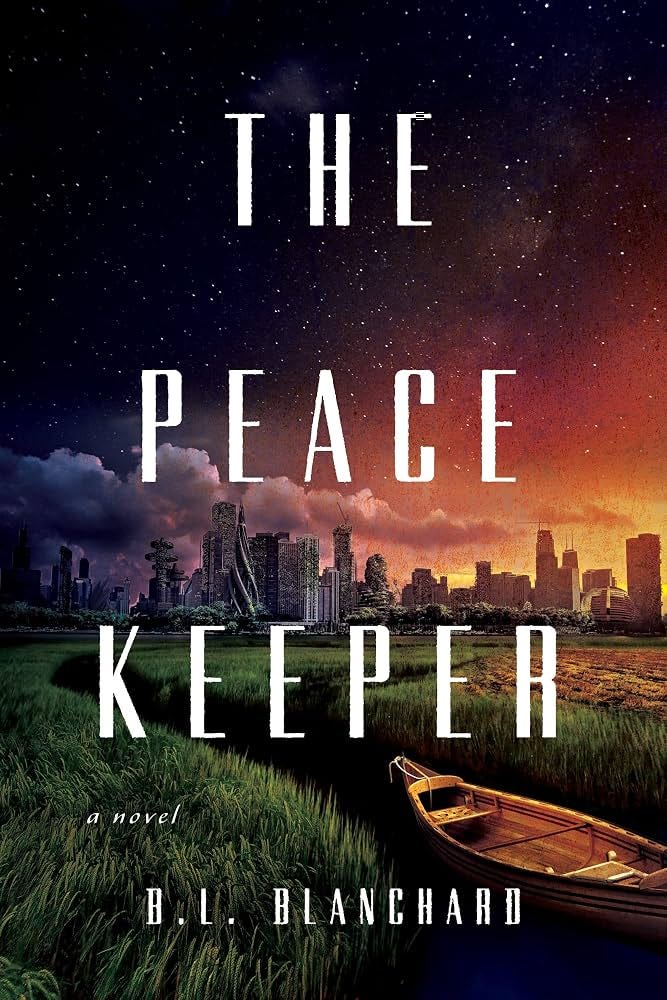
This month, I’m sharing my thoughts about B. L. Blanchard’s Sidewise Award-winning novel The Peace Keeper on Club Codex, where any Cosmic Codex subscriber can follow along, comment, or ask questions.
Here’s my first comment in the discussion thread:
”In the first twenty pages or so, Blanchard introduces us to her alternate world. It’s the 21st century, but Europe never colonized North and South America. The European nations still exist, on their own continent, but a vibrant community of indigenous nations occupies the region surrounding the Great Lakes, while extant Aztec, Inca, and Maya empires appear to dominate in the south. Chibenashi, our protagonist, is a Peacekeeper in a small village, where he struggles through each day, trying to do his job while taking care of his adult sister, Ashwiyaa. Both have been traumatized by the murder of their mother at the hands of their father twenty years earlier. In such a tight-knit community, where everyone knows everyone else’s business, they’ve been unable to move past this defining event in their lives.”
Click below to participate:

Authors: Turn Tech Chaos Into Calm, Clear Systems
Your email platform doesn’t talk to your course host. Your CRM doesn’t connect to your payment processor. And somewhere in that gap, you’re losing sales you’ll never be able to trace.
Tech chaos is one of the most common—and costly—problems facing author businesses today. According to a study from Slack, the average business owner loses up to 96 minutes of productivity every single day to fragmented tools. That’s three full weeks of wasted time per year.
Cloudessy’s fractional CTO services can help authors, coaches, and independent publishers simplify your tech stacks, prevent launch failures, and build systems that actually support growth.
Ready to stop fighting your tech?