


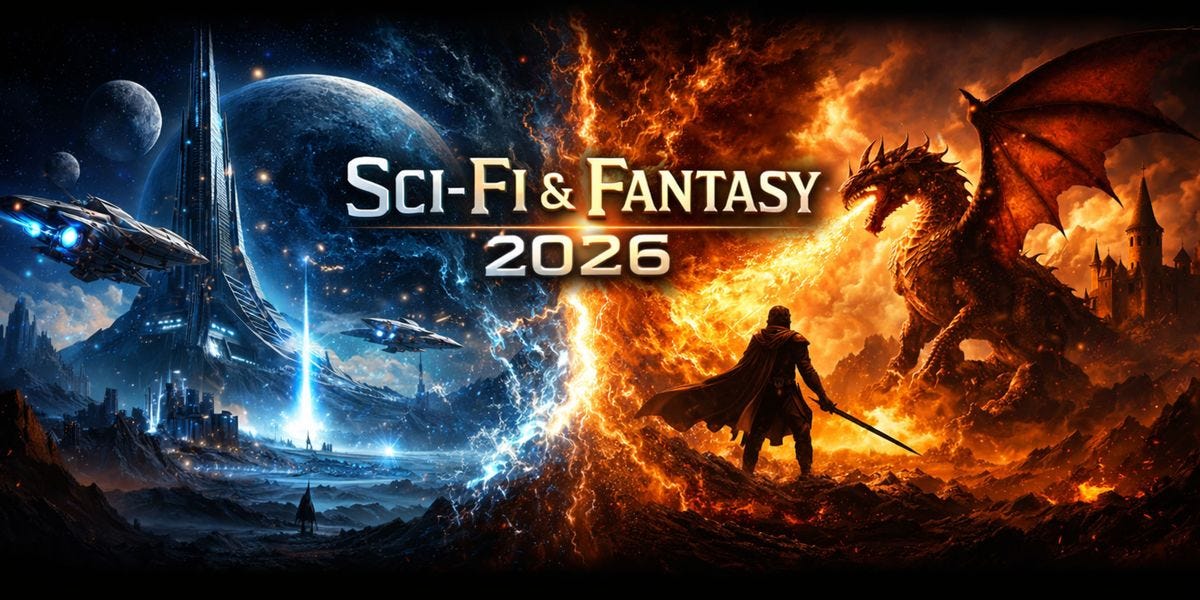
My novelette, An Illicit Mercy, is part of a promotion this year: Sci-Fi & Fantasy 2026.
Nearly 50 books, short stories, samples, and previews, available at no cost.
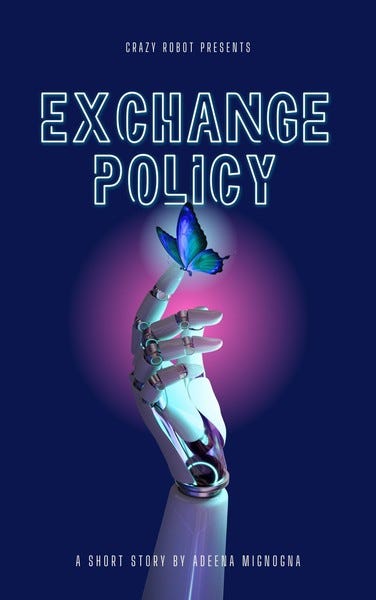
Customer service is everything, no matter how abhorrent the customer.
Get your FREE copy of Exchange Policy by Adeena Mignogna
Customer service is the most important thing these days—for humans and robots. The best ways to deliver great customer service is to know your product and all the ways it can be programmed, maintain a positive attitude, respond quickly, and focus support on the customer.
This is especially important when you’re in the business of contributing to other people’s families and unfortunately, and is regardless of whether or not you think the customer is worthy of your product...
Luckily, most of the robots we sell go to wonderful customers like Mrs. Borel. It means the days I have to deal with the Mrs. Vickers of the world are rare...
by Brian Scott Pauls
In 2023, Josephine Saxton won the Cordwainer Smith Rediscovery Award, which elevates the work of deserving, but lesser known, science fiction and fantasy writers.
When Saxton’s The Hieros Gamos of Sam and An Smith hit bookstore shelves in 1969, it did in fact carry the imprint name “Doubleday Science Fiction.”
It’s not science fiction. Not by today’s standards, at least. If this book were published in 2026, the publisher would almost certainly label it “magical realism.”
Ostensibly, what we have here is a post-apocalyptic narrative. A boy (but no dog, sorry) makes his way through the countryside of a nearly deserted England.
So far so good. And at first the world seems very post-apocalyptic indeed. In the first few pages we learn the boy is traveling alone and on foot. The environs through which he walks are very quiet. So quiet, in fact, that the song of a bird causes him to cry with joy.
“This morning he had seen a bird, and it had been singing, and the sound had excited him until he had tears running down his face, and he had been very happy. It was a long time since he had heard anything at all, except the sounds that he himself made.”1
What sort of apocalypse is this, that leaves a country so barren even sound is all but extinguished?
We might think a boy stranded in such a situation would be seeking help—perhaps an adult who could offer food and shelter. But the opposite is true.
“…if he ever saw another human being, and sometimes he did, he would avoid contact, and he knew that this was right, for in this way, trouble was avoided.”2
What do we have here? A plague? Perhaps a zombie plague? George Romero’s original Night of the Living Dead came out just a year before this book.
Soon the boy hears a sound he attributes to some sort of animal—perhaps a rabbit. At least we know there are animals (other than the occasional bird) left in this strange world! But Saxton quickly minimizes even this slight consolation:
“…it might be a rabbit although he knew this was a remote possibility, as he had only had one rabbit in his whole life.”3
In any case, the “rabbit” turns out to be a newborn baby girl, umbilical cord still attached to her dead mother. Here we get some insight into the boy’s response to mortality.
“Death and the dead must at all costs be avoided,”4 he thinks, and backs away “full of shock and distress.”5
Then Saxton throws us a curve ball.
“The boy was fourteen years old. He had been walking alone now for ten years…”6
Wait…this kid has been walking through a nearly silent world, avoiding people whenever possible, since he was four years old?
Subsequent events increase our perplexity. Against his better judgement, based on “rules” he’s learned (apparently at the age of three and four) from someone, the boy chooses to rescue the baby—even though he has no idea how to care for her.
He carries her to an empty town, finding a grocery store with an automatic door (that still functions after a decade) and shelves still stocked with soda water and condensed milk.
Later, he locates a bathhouse with functioning toilets and a pool still filled with chlorinated water heated to “a temperature of about eighty-three degrees Farenheit7.” Eventually he discovers an indoor shopping mall (also fully stocked) where the heat and even a coffee machine still work.
This is a very odd apocalypse.
That’s because we aren’t reading a science fiction novel. We’ve been hoodwinked by Doubleday’s late-60s marketing department. Instead of a literal end-of-civilization scenario, this apocalypse is a stand-in for something else.
The Hieros Gamos of Sam and An Smith is about the differences between boys and girls on the one hand, and women and men on the other. The empty world, seemingly devoid (or nearly so) of adults is more a representation of how the grown-up world is largely invisible to children, who are primarily the inhabitants of their own needs, desires, and imaginations.
This is symbolized by a monument the boy finds in the empty village.
“...he came upon a statue of a man on horseback, with an inscription beneath it. The inscription thus:
“’To the memory of those brave men of the town of Thingy, who gave their lives in the First World War.’”8
Here it’s important to understand the meaning of the word “thingy” in British English:
“a person or thing whose name one has forgotten, does not know, or does not wish to mention.”
You are unlikely to find the name “Thingy” on any map of Great Britain. Saxton is telling us we’re reading an allegory or parable, not a narrative to be interpreted literally.
In service of this project, she not only chooses to call her protagonist “the boy” in this part of the book, but gives him preferences and qualities readers in the 60s would have associated primarily with girls. He abhors being dirty, constantly longing for a bath and shampoo to wash his luxurious gold curls. He loves nail polish, and at one point enthuses over painting his nails a particularly eye-catching shade of red. He spends an inordinate amount of time picking out clothes, and on another occasion selects:
“…a bottle of nail varnish, an orange-to-pink shade that would go nicely with the grey silk of his shirt…and a spray of cologne that excited his senses, with the word ‘Femme’ written on it.”9
While this could be considered queer coding, both in 1969 and today, I think Saxton is up to something else. I think she’s implying boys and girls are much more similar than men and women, and the boy has yet to experience this transformation.
She also gives the boy a strong aversion to death. We’ve already seen how he reacts when encountering the baby’s dead mother. Another example is his response to reading the plaque on the war memorial: “The boy knelt down, and, not knowing why, howled with uncontrollable grief.”10
Generally speaking, children in a first-world country like England are socially protected from, and don’t understand, death. It’s alien to them. Confronted with its existence, they might react in a variety of ways. But for a teenage boy, sadness, depression, and even fear aren’t unreasonable possibilities.
Children, as represented by the boy, are inherently selfish. And Saxton seems to believe having children of our own is how many of us grow out of this selfishness.
At one point in the shopping mall, the boy leaves the baby sleeping by herself so he can pick out a new outfit. This is a process that takes a lot of time, as he is very particular about how he looks. He only remembers the baby when it’s nearly dark—and only then because she starts crying somewhere on a floor below. He tries to find his way back, but becomes confused and then lays down and goes to sleep—even though he knows she could suffer a horrible fate. We realize this when he wakes in the night and hears the baby crying.
“He thought…of the baby, attacked by rats; hungry, hard-jawed rats, alone in the chemist’s department, and in the morning, nothing. Nothing left but their stinking droppings.”11
Yet, despite this knowledge, the boy stays where he is rather than going to help a infant in obvious distress and possible danger.
But at the same time, its this same infant which prys open the boy’s soul and makes room in his life for more than himself. We see this when he finally returns to the baby in the morning.
“He clasped her to him, and fed her, and immediately she began to respond to the food, and his presence, and she changed as he watched her; all the tension eased from her, she nestled into him, and he planned to wash and change her, make her entirely comfortable, right the wrong he had done.
“‘I will never leave you alone again, baby,’ he murmured several times, and in his heart he meant it as a promise, and hoped that the baby understood.”12
Finally, Saxton depicts a vital interdependence between the sexes, in which we raise one another to maturity. To say much more would stray into spoiler territory.
Suffice it to say the boy and the baby girl live together in their shopping-mall-as metaphor for many years, with him acting as her protector and teacher. How their relationship changes when the girl reaches maturity will shock the sensibilities of many contemporary readers who insist on interpreting the story literally.
But for Saxton it’s all part of the parable. The girl, who has become a young woman, now takes on the role of teacher for the boy, who in large part has remained emotionally stunted. It is she who guides him into what, in her estimation, it means to be a man who is prepared to take on the responsibilities that label implies in the modern society of Saxton’s 1969. Only when they have both been prepared for, and accepted, their roles, does the metaphor around them dissolve and usher them into the adult world waiting to welcome them.
This is not a book I would have read if it had not been presented as science fiction. But I’m glad I read it. Some of the ideas seem dated, even antique by today’s standards. Yet Saxton presents a female character stronger than her male counterpart, who eventually rises to the challenge of completing the formation of his character as a responsible adult.
Not recommended for someone who is expecting a post-apocalyptic adventure tale, or for anyone shocked by metaphors that come across as highly transgressive to current readers if taken literally.
Highly recommended for anyone who wants to read a mid-century argument about human nature and changes in relations between the sexes framed as a surreal parable.
Thoughts Josephine Saxton or her novel The Hieros Gamos of Sam and An Smith? Share them by leaving a comment below!
Artificial intelligence tools performed multiple tasks in the creation and publication of this article.
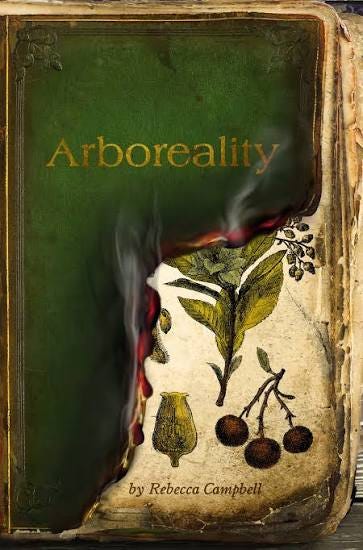
This month, I’m reading Rebecca Campbell’s Ursual K. Le Guin Award-winning novel Arboreality. I’m sharing my thoughts on Club Codex, where any Cosmic Codex subscriber can follow along, comment, or ask questions.
From this week’s post:
“…an uncompromising look at the possible impact of climate change on North America...This mean[s] it’s depressing, but not as depressing as David Wallace-Wells’ 2017 article “The Unihabitable Earth”…Campbell, by contrast, seems to believe both that our biosphere can adapt to higher temperatures…and that humanity can adapt with it…So it’s more about the demise of our way of life…than our species.”
Click below to participate:

Authors: Turn Tech Chaos Into Calm, Clear Systems
Your email platform doesn’t talk to your course host. Your CRM doesn’t connect to your payment processor. And somewhere in that gap, you’re losing sales you’ll never be able to trace.
Tech chaos is one of the most common—and costly—problems facing author businesses today. According to a study from Slack, the average business owner loses up to 96 minutes of productivity every single day to fragmented tools. That’s three full weeks of wasted time per year.
Cloudessy’s fractional CTO services can help authors, coaches, and independent publishers simplify your tech stacks, prevent launch failures, and build systems that actually support growth.
Ready to stop fighting your tech?

Saxton, Josephine. “The Hieros Gamos of Sam and An Smith,” Doubleday & Company, Inc. 1969. p. 3
Ibid.
Ibid. p. 8
Ibid. p. 9
Ibid. p. 10
Ibid. p. 11
Ibid. p. 29
Ibid. p. 35
Ibid. p. 33
Ibid. p. 35
Ibid. pp. 49-50
Ibid. pp. 53-54


